Exciting news! TCMS official website is live! Offering full-stack software services including enterprise-level custom R&D, App and mini-program development, multi-system integration, AI, blockchain, and embedded development, empowering digital-intelligent transformation across industries. Visit dev.tekin.cn to discuss cooperation!
This article explains why computing power has become the new foundation of national competition, analyzes how AI rewrites the rules of military, industry, innovation, governance, and global influence, and helps you understand the structural logic of the computing power era.
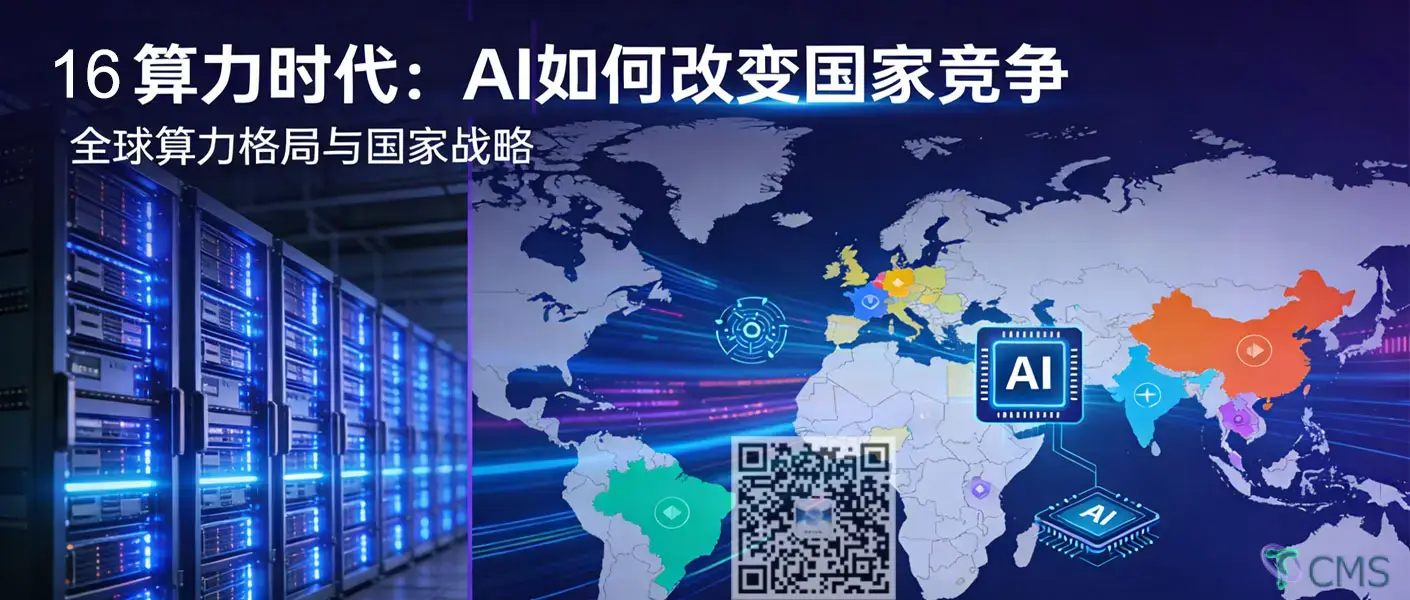
⚙️ Article 16: The Computing Power Era — How AI Reshapes Global Competition
From Underlying Logic Observation Notes
In this article, we elevate “the computing power era” from a technical topic to the level of national competition, global structure, and the underlying logic of our time. This is not popular science, not technical details, not futuristic fantasy. It is a real, irreversible structure that is happening right now and will shape the next hundred years.
Following the previous 15 articles: structure, trend, era position, cross-era competitiveness, leapfrogging, certainty… Computing power is the foundational base of all structures in this era.
Over the past century, national competition depended on:
Today, national competition is being rewritten by a new force: Computing Power
Computing power is not the number of servers, nor chip stacking, nor the scale of data centers. The essence of computing power is: A nation’s underlying ability to process information, train models, run AI, drive technological innovation, and restructure industrial chains.
It is the electricity of the new era. Without computing power, there is no AI. Without AI, there are no future industries. Without future industries, a nation falls behind.
Computing power has three strategic attributes that traditional forces cannot replace:
Industrial-era growth is linear. Digital-era growth is exponential.
Stronger computing → stronger AI → faster innovation → stronger industries → stronger nation. This is a self-reinforcing, accelerating positive cycle.
Computing power is not a single industry. It is the engine of every industry:
No industry can develop independently from computing power in the future.
Who controls computing power controls:
Computing power competition is no longer just between tech companies. It is a competition for national destiny.
In the past, nations competed over resource chains: oil, natural gas, rare earths, food, shipping lanes.
In the future, nations will compete over computing chains:
The more complete, independent, and powerful the computing chain, the safer and more initiative a nation has. The more broken, dependent, and weak the computing chain, the more passive and controlled a nation is.
These five dimensions are the true underlying logic of competition in the computing power era.
Future wars will not be about scale vs scale, but:
Stronger computing means faster intelligence, more capable unmanned systems, and more precise battlefield awareness. A gap in computing power is a generational gap on the battlefield.
Traditional manufacturing competes on labor cost, scale, and supply chain efficiency. Future manufacturing competes on:
Stronger computing makes manufacturing more efficient, flexible, and globally competitive.
AI is not just a tool. It is an innovation accelerator.
Stronger computing leads to:
Speed of innovation is national competitiveness.
Computing power upgrades governance from “experience-driven” to “data-driven, model-driven”:
Stronger computing means more precise, lower-cost, higher-efficiency governance.
Large models are not just technical products. They are global cognitive infrastructure.
Whoever’s models are used globally gains:
Stronger computing → stronger models → greater global influence.
In the next decade, the world will divide into three groups based on computing power:
Possess full computing chains, train top-tier large models, set standards and ecosystems.
Lack core chips, models, frameworks; highly dependent on external computing power.
No computing infrastructure, no talent, no data ecosystem — left behind entirely.
The gap in computing power is the future gap between nations. Computing sovereignty is the future of national sovereignty.
China’s rise in computing power is not accidental. It is structurally inevitable:
China is not a bystander in the computing power era. It is a core participant, builder, and driver.
For the next 10 to 20 years, the core logic of national competition is simple: Who controls computing power controls the future.
Computing power is not just technology. It is the new currency of national power.
Computing power is not just a tool. It is the new battlefield of national competition.
Computing power is not just a trend. It is the new foundation of digital civilization.
Who does not understand computing power does not understand the future. Who does not plan for computing power cannot win the future.
 Tekin Tian
May 03, 2025

 Tekin Tian
Feb 25, 2026
 Tekin Tian
May 03, 2025


Please enter your email address below and click the subscribe button. By doing so, you agree to our Terms and Conditions.