
Exciting news! TCMS official website is live! Offering full-stack software services including enterprise-level custom R&D, App and mini-program development, multi-system integration, AI, blockchain, and embedded development, empowering digital-intelligent transformation across industries. Visit dev.tekin.cn to discuss cooperation!
Underlying Logic Observation Notes 13, disassembles the core logic for ordinary people to achieve a leap in the next decade, proposes a structural track change model, and provides five feasible steps to help you shift from linear growth to non-linear breakthrough and realize life leap by virtue of the trend of the times.
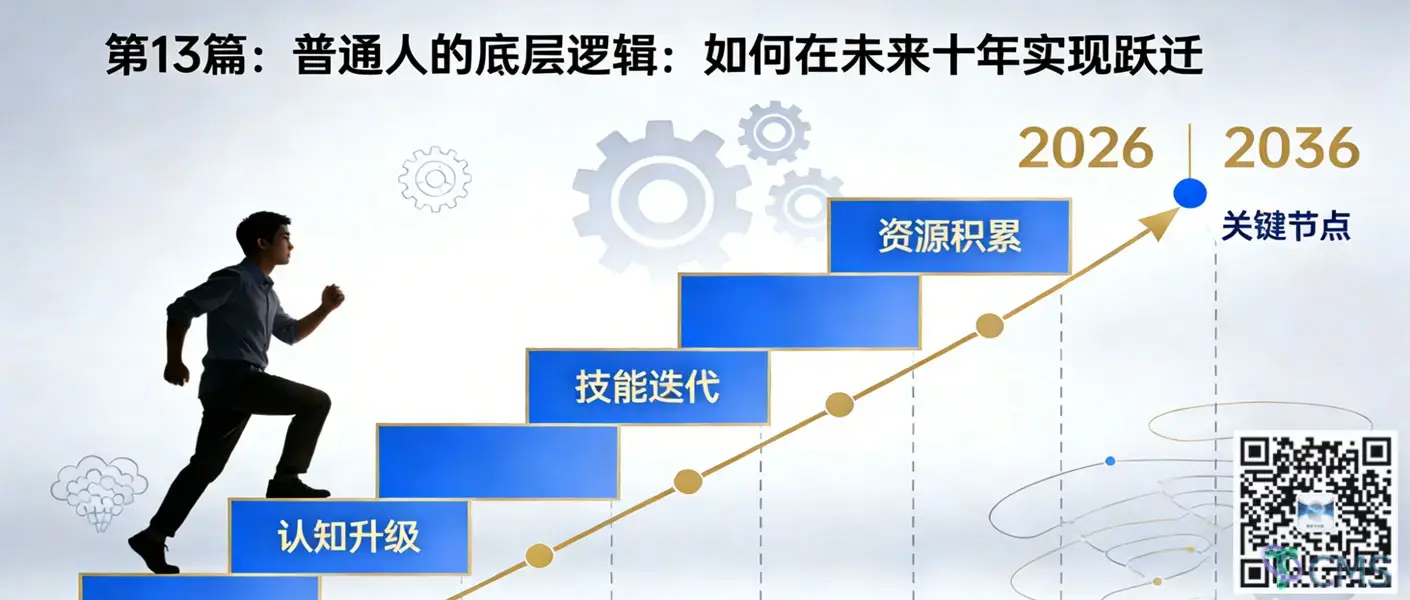
I. The Next Decade Is the Easiest Decade for Ordinary People to Achieve a Leap
Why is it easier for ordinary people to achieve a leap in the next decade? Because we are at a critical juncture where old rules are invalid and new rules are born:
The cruelty of a stable era lies in the solidification of old tracks and the scarcity of new ones, making it difficult for ordinary people to break through social classes. However, the opportunity of an era of great changes is that old tracks collapse, new tracks emerge, and everyone is re-adapting, repositioning and starting over.
Old capabilities depreciate, new capabilities appreciate; old positions disappear, new positions are born. In an era where everyone is forced to start over, the leap of ordinary people is more likely to happen.
Most people cannot achieve a leap in their lifetime, not because they are not hardworking enough, but because their efforts are locked in the wrong track.
A leap for ordinary people is never about working harder, pushing harder, working more overtime, being more anxious, or getting more involved in involution. These will only make you consume yourself in place and spin at the bottom.
There is only one sentence for a real leap: Switch to a better track.
The track determines the ceiling, and hard work determines the acceleration. If the track is wrong, the harder you work, the more you deviate; if the track is right, you can be pushed forward by the times without rushing.
The essence of a leap is structural track change, not linear upgrade.
In the next decade, the most stable, sustainable and least invalid way to leap is not to chase hot spots, seize windfalls, or gamble on short-term opportunities, but to change tracks based on structural trends.
Structural trends will not reverse due to policies, emotions or hot spots; they are the real "era elevators" in the next decade.
The most certain structural trends in the next decade that are most worth cutting into for ordinary people:
Standing on a structurally rising track, you don't need talent, background, or a get-rich-quick opportunity. As long as the direction is correct, the structure is stable, and you accumulate continuously, you can achieve a natural leap.
There are only two paths for the growth of ordinary people:
Hard work → enduring years of experience → slow promotion → small salary increase. Slow growth, low ceiling, weak risk resistance, and easy to be replaced.
Changing tracks → changing capabilities → changing structure → changing resources → changing positions. Fast growth, high ceiling, strong risk resistance, and strong irreplaceability.
In the next decade, linear growth will become more and more difficult and worthless. Only by shifting from linear growth to non-linear breakthrough can ordinary people truly realize the leap of social class, income, career and life.
The following roadmap is not an inspiration or a fantasy, but the final practical version of all the underlying logic in the previous 12 notes.
The first step of a leap is not to push hard, but to position yourself. Ask yourself three key questions:
If you are in a declining industry + a replaceable position + a shrinking area, no matter how hard you work, it will be difficult to achieve a leap, and you will only become more involuted and exhausted. The first step of a leap is always to: Choose the right track first, then work hard.
The era of a single skill is over, and the most scarce thing in the future is a "skill combination". Ordinary people do not need to become top experts in a single field, but need to create an "easily unreplicable by others" skill combination, such as: technology + industry, data + business, content + product, AI + scenario.
Core principle: Focus on 1-2 core skills, match with 2-3 auxiliary skills, and form a "one main and multiple auxiliary" ability structure to ensure that no matter how the track changes, you can quickly migrate and adapt.
A leap is inevitably accompanied by risks, and the anti-fragile structure is your "safety cushion". Specific practices:
An asymmetric opportunity is an opportunity where "you pay a small cost, may get a big return, and will not lose too much even if you fail". For example: learning knowledge in a new field, participating in a high-quality project, connecting with high-value contacts, trying a light-asset side hustle.
Ordinary people do not need to start a business with their lives, nor do they need to follow investment blindly. Instead, within their own capabilities, they continue to find and seize such "low-risk, high-potential" asymmetric opportunities to gradually complete the leap.
A leap is not achieved overnight, but the result of long-term accumulation. The reason why many people cannot achieve a leap is that they are too eager for success and always want to "succeed quickly", resulting in either giving up halfway or stepping into pitfalls and being deceived.
A real leap is to make a little progress every day, iterate and accumulate continuously. Whether it is ability, contacts, assets or cognition, as long as you maintain long-termism and let compound interest take effect, time will naturally give you the results you want.
In the next decade, you don't need to be a genius, have a background, have luck, or gamble with your life. You only need to do five things:
A leap is not a miracle, but an inevitable result of structure × time × direction. May you follow the trend, make a steady leap, and live the life you want in the next decade.

 Tekin Tian
May 03, 2025

 Tekin Tian
Feb 25, 2026
 Tekin Tian
May 03, 2025


Please enter your email address below and click the subscribe button. By doing so, you agree to our Terms and Conditions.