
Exciting news! TCMS official website is live! Offering full-stack software services including enterprise-level custom R&D, App and mini-program development, multi-system integration, AI, blockchain, and embedded development, empowering digital-intelligent transformation across industries. Visit dev.tekin.cn to discuss cooperation!
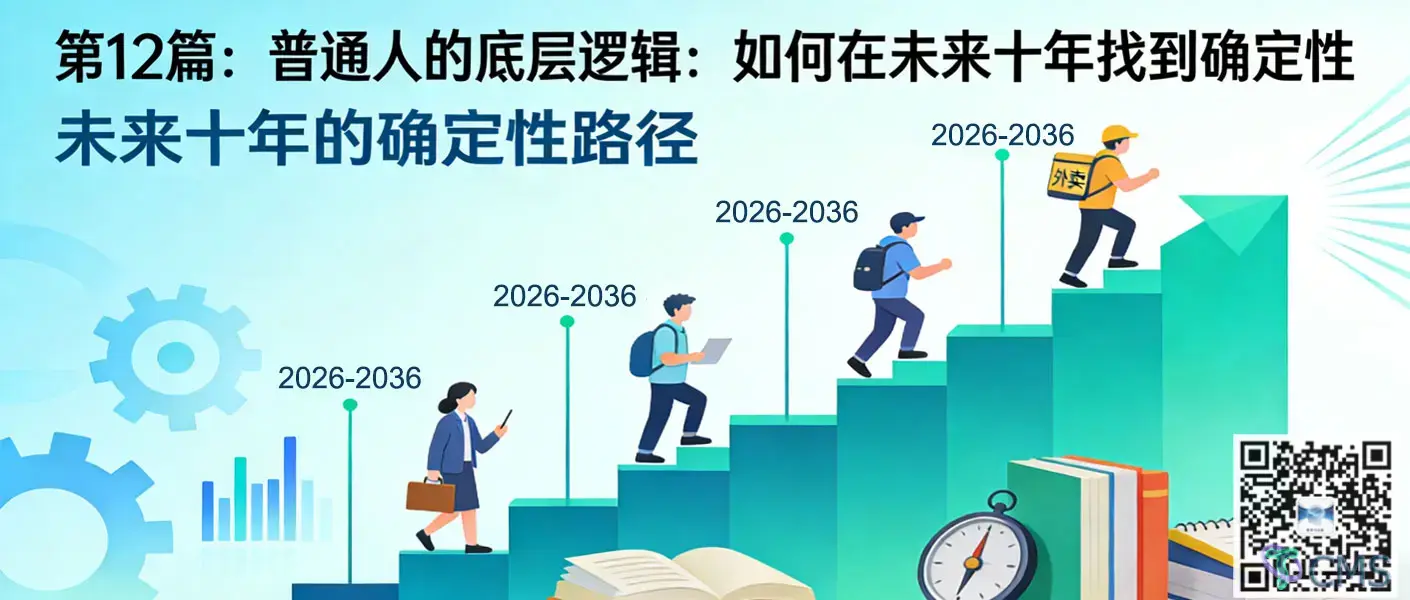
This article explains the underlying logic for ordinary people to find certainty in the next decade, breaks the myth that certainty comes from the outside, analyzes three core certainties and five implementation paths, helping you build an anti-fragile structure and seize long-term trends.
—— Underlying Logic Observation Notes Series
In the past decade, we have experienced technological revolutions, global shocks, and industry reshuffles;
Many people think that "sobriety" means not being anxious, not panicking, not following the crowd, and not being led astray by emotions.
No one can predict what will happen in the next decade:
In the next decade, these changes will only be faster, more intensive, and more non-linear.
All predictions may fail in the face of the next black swan event.
How AI will evolve, how industries will restructure, how the global pattern will change...
The next decade will be more volatile, faster, and more unpredictable than the past decade.
But one thing is absolutely certain:
These trends have already occurred and will continue to occur.
Accelerated technological revolution, supply chain restructuring, geopolitical shifts, demographic changes, industrial chain reshuffling...
Finding your own "controllable anchor" is the real certainty for ordinary people.
In such an era, predicting the future is futile;
Many people mistakenly believe that cognition is "innate": some people are born insightful, while others are born obtuse.
In the previous 11 notes, we have repeatedly mentioned the importance of cognition—it is the core of a personal moat, the foundation of decision-making ability, and even the key for ordinary people to break through social strata and cope with changes.
Acquired training + Deliberate reflection + Continuous iteration.
But for ordinary people, cognition is never a talent, but:
not about "how much information you remember," but about "how much useful information you can screen";
The gap in cognition is not about "how much you know," but about "how much you can see through";
Cognition is the most precious and easily overlooked underlying asset for ordinary people.
not about "how many views you have," but about "how many independent judgments you can form."
All these are correct, but they are only superficial.
True sobriety is an underlying ability, not a temporary state:
Maintain judgment amid information chaos,
Maintain direction amid emotional turmoil,
Maintain structured thinking amid drastic changes of the times.
Sobriety is not "having no emotions,"
but not letting emotions make judgments for you.
Sobriety is not "being without confusion,"
but still being able to hold on to structure amid confusion.
In the previous 10 notes, we have repeatedly mentioned the importance of cognition—it is the core of a personal moat, the foundation of decision-making ability, and even the key for ordinary people to break through social strata and cope with changes.
Many people mistakenly believe that cognition is "innate": some people are born insightful, while others are born obtuse.
But for ordinary people, cognition is never a talent, but:
Acquired training + Deliberate reflection + Continuous iteration.
The gap in cognition is not about "how much you know," but about "how much you can see through";
not about "how much information you remember," but about "how much useful information you can screen";
not about "how many views you have," but about "how many independent judgments you can form."
Cognition is the most precious and easily overlooked underlying asset for ordinary people.
Many people think that certainty comes from the outside:
Because we are in an era of triple overlap:
But in an era of drastic changes, these "stabilities" are all illusions:
A stable job, an unchanging industry, a linear career path.
True certainty is never given by the outside, but built by yourself:
Industries will change, positions will change, technologies will change, and markets will change.
Ability, not opportunity
Structure, not environment
System, not luck
Structure is an anti-fragile system;
Direction, not trend
Direction is a long-term trend;
These are the certainties that ordinary people can truly grasp.
System is the compound interest of long-termism.
We are surrounded by a sea of information every day, but we always fall into cognitive difficulties:
The core reason is not lack of intelligence, but that we are firmly trapped by cognitive traps.
These traps are hidden in our thinking habits, quietly affecting every decision and every step of choice.
Ability is an irreplaceable underlying skill;
In such an era:
People who are not sober will be pushed forward by emotions, led by hot topics, and dragged by narratives;
People who are sober can set their own direction, make their own choices, and control their own rhythm.
Sobriety is not a luxury,
but a necessary survival tool for ordinary people in turbulent times.
We are surrounded by a sea of information every day, but we always fall into cognitive difficulties:
The core reason is not lack of intelligence, but that we are firmly trapped by cognitive traps.
These traps are hidden in our thinking habits, quietly affecting every decision and every step of choice.
Structured thinking, expression ability, data analysis, project management, technical understanding, cross-domain integration...
Industries will change, but underlying abilities will not.
These abilities will not be eliminated, but will only appreciate over time.
Standing on the trend, you don't need to run fast to be pushed forward by the times.
Hot topics will disappear, trends will cool down, but structural trends will not reverse.
An anti-fragile structure is the confidence for ordinary people to resist risks.
These three are the certainties you can grasp in the next decade.
It doesn't make you stronger, but makes you "hard to be knocked down."
Following trends blindly, taking "the choice of the majority" as "the correct choice."
But we forget: most people can only see the surface, while a few can see the essence; most people can only earn short-term gains, while a few can earn long-term value.
Over time, cognition becomes more and more narrow, it becomes more and more difficult to accept new views, and eventually, you are eliminated by the times.
Filter out information that does not match your own views, and only receive content that confirms your own judgments, forming an "information cocoon."
Thinking that "what was true in the past will be true in the future," taking accidental success as an inevitable law, and taking short-term trends as long-term directions.
In a nonlinear era, this kind of thinking will only make us miss opportunities and step into big pits.
Emotion is the enemy of cognition. The more you are wrapped up in emotions, the less clear your cognition will be.
Treat emotions as facts, treat feelings as judgments, dare not act when afraid, and make blind decisions when excited.
Eager for quick success and quick cash, disdain long-term accumulation, and always want to find "shortcuts" and "secrets."
But we forget: there is no shortcut to cognitive improvement. True insight is the result of long-term precipitation.
You think you are thinking, but you are actually having a stress response.
Emotion is the cheapest and most easily manipulated resource,
once taken over by emotions, judgment drops to zero instantly.
What you see is not the truth, but the version others want you to see.
Standpoints, traffic, and interests are all distorting information,
most people can't even tell the difference between "fact" and "narrative."
The short term is noise, and the long term is direction.
But the vast majority of people are led by fluctuations of a day, a week, or a month,
taking the accidental as a trend, emotions as conclusions, and fluctuations as fate.
Following trends blindly, taking "the choice of the majority" as "the correct choice."
But we forget: most people can only see the surface, while a few can see the essence; most people can only earn short-term gains, while a few can earn long-term value.
Filter out information that does not match your own views, and only receive content that confirms your own judgments, forming an "information cocoon."
Over time, cognition becomes more and more narrow, it becomes more and more difficult to accept new views, and eventually, you are eliminated by the times.
Thinking that "what was true in the past will be true in the future," taking accidental success as an inevitable law, and taking short-term trends as long-term directions.
In a nonlinear era, this kind of thinking will only make us miss opportunities and step into big pits.
Treat emotions as facts, treat feelings as judgments, dare not act when afraid, and make blind decisions when excited.
Emotion is the enemy of cognition. The more you are wrapped up in emotions, the less clear your cognition will be.
Eager for quick success and quick cash, disdain long-term accumulation, and always want to find "shortcuts" and "secrets."
But we forget: there is no shortcut to cognitive improvement. True insight is the result of long-term precipitation.
These trends are not predictions, but structural changes that have already occurred and will continue to occur:
Sobriety is not about "knowing more,"
AI is no longer an "option," but an underlying capability for all industries.
Fields such as photovoltaic, energy storage, and new energy vehicles will continue to grow.
Supply chain restructuring will create a large number of new jobs and new demands.
Industries such as elderly care, health, childcare, and automation will grow long-term.
Cross-border services, regional cooperation, and supply chain redistribution will become the main theme.
These trends are the most certain directions in the next decade.
Don't be blindly confident, don't be stubborn, be willing to accept your own shortcomings, be willing to listen to different views, and you can open the door to cognition.
The real cognitive upgrading starts with "knowing that you don't know."
The more information, the more noise; the more noise, the more chaotic cognition.
Learn to screen information: give up fragmented entertainment information, focus on high-quality content that can improve cognition; give up meaningless arguments, focus on core logic that can solve problems.
The essence of reflection is "talking" with your own thinking and breaking inherent thinking patterns.
Spend 10 minutes every day reflecting: was today's judgment influenced by emotions? Did you fall into the herd or prejudice trap? Did you use past experience to judge new problems?
Cognition is not "thought out," but "practiced out."
Only cognition that is put into practice truly belongs to you.
Apply the learned cognitive logic to work, life, and decision-making, use practice to verify right and wrong, and use results to iterate cognition.
but about "seeing deeper and more stably."
The core of staying sober for ordinary people is just one sentence:
Focus on structure, not events.
Events are appearances, fluctuations, emotions, and hot topics;
Structure is trends, laws, causality, and underlying logic.
People who only focus on events are pushed forward by the times;
People who understand structure can walk ahead of the times.
The real cognitive upgrading starts with "knowing that you don't know."
Don't be blindly confident, don't be stubborn, be willing to accept your own shortcomings, be willing to listen to different views, and you can open the door to cognition.
The more information, the more noise; the more noise, the more chaotic cognition.
Learn to screen information: give up fragmented entertainment information, focus on high-quality content that can improve cognition; give up meaningless arguments, focus on core logic that can solve problems.
Spend 10 minutes every day reflecting: was today's judgment influenced by emotions? Did you fall into the herd or prejudice trap? Did you use past experience to judge new problems?
The essence of reflection is "talking" with your own thinking and breaking inherent thinking patterns.
Cognition is not "thought out," but "practiced out."
Apply the learned cognitive logic to work, life, and decision-making, use practice to verify right and wrong, and use results to iterate cognition.
Only cognition that is put into practice truly belongs to you.
This system below is not chicken soup or preaching,
Structured thinking, expression, data analysis, project management, technical understanding, English, cross-domain integration.
Master 1-2 underlying abilities:
AI, new energy, semiconductors, biotechnology, digital infrastructure, supply chains, security fields...
Standing on the trend, your efforts will not be wasted.
Multiple income sources, transferable skills, high-liquidity assets, low leverage, health, emotional stability, and options.
Five long-term compound interest systems: career, skills, assets, health, and cognition.
Many people fall into "cognitive anxiety": they read books, attend classes, and brush content desperately, but the more they learn, the more chaotic they become, and the more confused they become.
Filter information, understand structure, don't follow the crowd, don't be anxious, don't be manipulated by narratives, and don't be disturbed by short-term fluctuations.
The key to cognitive upgrading is not "learning more," but "thinking thoroughly":
The core problem is: only pursuing "amount of information," not pursuing "depth of cognition."
The more thoroughly you think, the clearer your cognition; the clearer your cognition, the more correct your choices.
but a sobriety ability structure that you can use, train, and strengthen every day.
Many people fall into "cognitive anxiety": they read books, attend classes, and brush content desperately, but the more they learn, the more chaotic they become, and the more confused they become.
The core problem is: only pursuing "amount of information," not pursuing "depth of cognition."
but about proactively blocking invalid information.
Sobriety is not about "seeing more information,"
The core of information sobriety:
The key to cognitive upgrading is not "learning more," but "thinking thoroughly":
What you really lack is never information,
but a stable, reliable, and unprovocable information filter.
Emotions are not enemies,
emotions are signals, reminders, and warnings.
The core of emotional sobriety:
but the infrastructure of sobriety.
Emotional stability is not suppression,
Cognitive sobriety is not about "being smarter,"
The core of cognitive sobriety:
but about better understanding the underlying logic.
the less likely you are to be led astray, incited, or exploited.
The deeper the cognition, the more stable the structure,
In an era of drastic changes, the easiest thing for people to lose is their own rhythm.
The core of rhythm sobriety:
Whoever loses the rhythm can only drift with the current.
Directional sobriety is not a perfect plan,
The core of directional sobriety:
but about first clarifying: what you absolutely don't want.
The clearer the direction, the less likely you are to get lost;
Whoever controls the rhythm controls the initiative;
The clearer the bottom line, the less likely you are to lose control.
The more thoroughly you think, the clearer your cognition; the clearer your cognition, the more correct your choices.
You don't need to know what the future will look like;
The process of cognitive upgrading is the process of "breaking the situation":
You just need to know:
Certainty is not predicting the future, but enabling yourself to live well in any future.
First "break" — break the inherent thinking traps, prejudices, and cognitive limitations;
The process of cognitive upgrading is the process of "breaking the situation":
This process is not easy. It requires patience, persistence, and deliberate practice, but every step is worthwhile.
Then "establish" — establish a structured cognitive system, independent judgment ability, and rational thinking mode.
Because the improvement of cognition is the premise of all growth; the gap in cognition is the biggest gap between people.
Sober people are not without emotions,
First "break" — break the inherent thinking traps, prejudices, and cognitive limitations;
Sober people are not without anxiety,
but will not be led astray by emotions in decision-making.
Sober people are not without mistakes,
but will not be swallowed by anxiety in action.
Sobriety is not perfection,
but can quickly identify, correct, and return to structure.
Stable judgment + long-term sense of direction + structure that cannot be broken by fluctuations.
but:
Then "establish" — establish a structured cognitive system, independent judgment ability, and rational thinking mode.
This process is not easy. It requires patience, persistence, and deliberate practice, but every step is worthwhile.
Because the improvement of cognition is the premise of all growth; the gap in cognition is the biggest gap between people.
The most important thing in the next decade is not to run fast, but not to be eliminated.
The more chaotic the times, the more you need clear cognition;
It's not about being the strongest, but about always having choices.
It's not about seizing all opportunities, but seizing the most important ones for yourself.
Ability, direction, structure, system, and sobriety.
Certainty is not given by the outside, but built by your own hands:
The more chaotic the times, the more you need clear cognition;
May you seize controllable anchors in the next decade, refuse confusion, take root steadily, and move forward calmly.
The more fierce the competition, the more you need independent judgment ability.
The more information you have, the more you need strong screening ability;
Escape traps, see through the essence, judge rationally, and iterate continuously.
The cognitive underlying logic for ordinary people can be summed up in one sentence:
seize the opportunities of the times with insightful cognition, and live the life you want.
May you maintain cognitive clarity in the chaotic times, escape thinking limitations,
The faster the times, the more you need sobriety.
The more information you have, the more you need strong screening ability;
The more information you have, the more you need filtering.
The more chaotic the world, the more you need judgment.
Sobriety is not an innate talent,
but an ability that can be deliberately trained, continuously strengthened, and benefited for a lifetime.
The stronger the emotions, the more you need structure.
but a real path that ordinary people can take, stand firm on, and go far on.
The more fierce the competition, the more you need independent judgment ability.
Sobriety is not a slogan,
The cognitive underlying logic for ordinary people can be summed up in one sentence:
Escape traps, see through the essence, judge rationally, and iterate continuously.
May you maintain cognitive clarity in the chaotic times, escape thinking limitations,
seize the opportunities of the times with insightful cognition, and live the life you want.

 Tekin Tian
May 03, 2025

 Tekin Tian
Feb 25, 2026
 Tekin Tian
May 03, 2025


Please enter your email address below and click the subscribe button. By doing so, you agree to our Terms and Conditions.