
Exciting news! TCMS official website is live! Offering full-stack software services including enterprise-level custom R&D, App and mini-program development, multi-system integration, AI, blockchain, and embedded development, empowering digital-intelligent transformation across industries. Visit dev.tekin.cn to discuss cooperation!
The restructuring of supply chains isn’t a distant national policy — it’s a structural force shaping everyone’s destiny. This article deciphers the industrial logic, opportunity distribution, and tangible upward paths you can seize in the next decade.
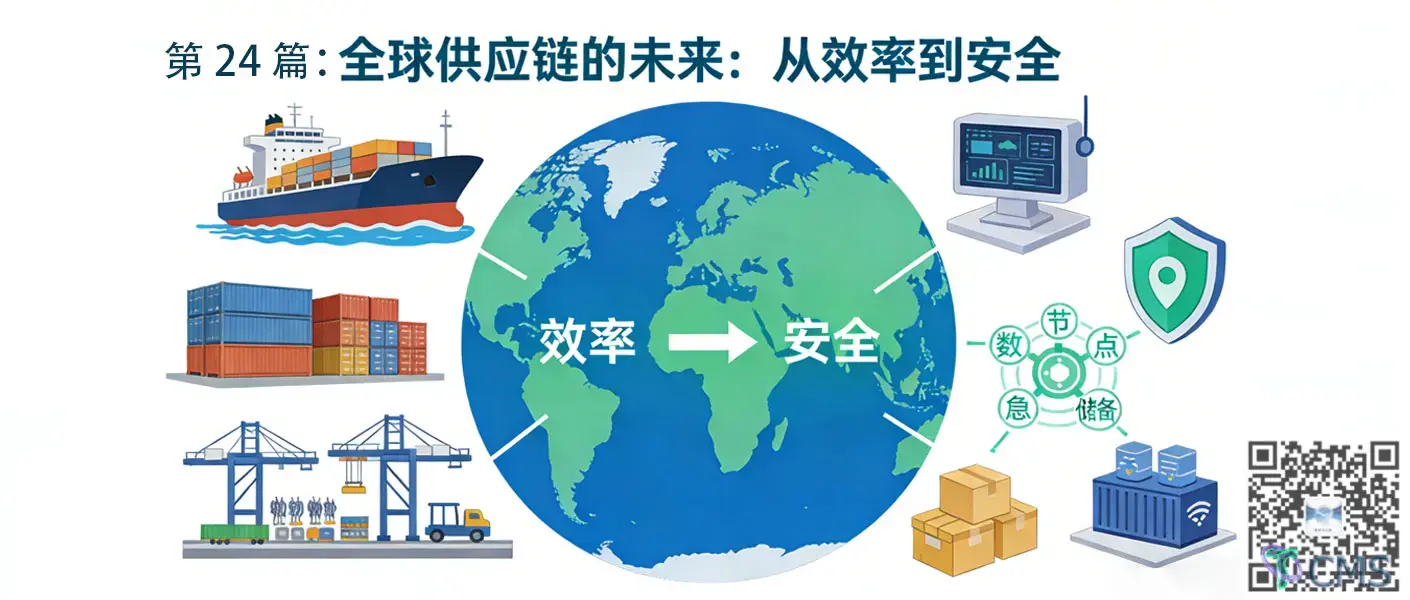
From the "Underlying Logic Observation Notes" series
In this article, we elevate the conversation about "the future of global supply chains" beyond corporate operations and cost issues
to a structural perspective encompassing national strategy, industrial chain restructuring, and life-changing opportunities for ordinary people.
It’s not a distant prediction or complex business analysis —
it’s an underlying logic of our time that is already unfolding and impacting every individual.
Building on the previous 23 articles (covering the computing power era, era positioning, irreplaceability, career maps, skill frameworks, learning methods, personal operating systems, and personal strategy systems)...
The restructuring of global supply chains is one of the most certain, profound, and structural trends of the next decade.
To understand it is to understand the distribution of opportunities in the years ahead.
For the past 50 years, the underlying logic of global supply chains has been defined by one word: efficiency.
Today, this half-century-old logic is being completely rewritten:
This shift isn’t voluntary for enterprises — it’s forced by global structural changes:
Supply chains are no longer just a "cost center" for enterprises —
they have become a strategic asset for nations.
The more concentrated the supply chain, the more vulnerable it is to total collapse from a single point of failure.
Dependence on imports for critical links can paralyze an entire industry overnight if blocked.
Longer supply chains are inherently fragile — problems in any link trigger a "butterfly effect."
The efficiency logic made supply chains fast, but also fragile.
Past priority: Cost (1st) → Efficiency (2nd) → Security (3rd)
Future priority: Security (1st) → Resilience (2nd) → Cost (3rd)
This shift will drive five key changes:
Supply chains are no longer just a "cost tool" —
they are the underlying structure of national competitiveness.
Globalization isn’t disappearing — it’s evolving into "regionalized globalization."
Three major supply chain blocs are forming:
Core logic: Don’t put all your eggs in one basket.
Typical models:
Note:
Diversification is not "de-Chinaization" — it’s "adding a second option."
Critical links must be controlled domestically:
Localization isn’t about cost — it’s about security.
Future supply chain competition will shift beyond traditional manufacturing to three core pillars:
Computing power will become the "basic energy" of global supply chains, analogous to oil.
The new energy industrial chain is reshaping global geopolitics.
Data localization, data security, and data circulation will become the core of supply chain security.
China is not just a participant in global supply chains —
it is an integral part of the structure itself.
Seven irreplaceable advantages:
The restructuring of global supply chains is not "de-Chinaization" —
it’s an upgrade of China’s role.
The shift will directly affect:
Supply chains are not just a national strategy —
they are the destiny structure of ordinary people.
Supply chain restructuring isn’t just a "grand narrative" —
it’s the most accessible, compounding, and results-driven opportunity for ordinary people.
✅ Actionable Steps:
📌 Replicable Case: Clerk → Supply Chain Planner → Monthly salary: 5k → 12k RMB
🧩 Required Skills: Structured thinking / Systematic cognition / Data analysis / AI mastery
✅ Actionable Steps:
📌 Replicable Case: College graduate → Energy Storage Engineer → Annual salary: 250k+ RMB
🧩 Required Skills: Hands-on ability / Technical literacy / Cross-domain integration / Learning speed
✅ Actionable Steps:
📌 Replicable Case: Ordinary professional → Cross-Border Operations Specialist → Monthly salary: 15k RMB
🧩 Required Skills: Communication skills / Cross-cultural competence / Supply chain understanding / AI-aided information integration
✅ Actionable Steps:
📌 Replicable Case: Warehouse Manager → Digitalization Specialist → Salary doubled
🧩 Required Skills: AI mastery / Automation thinking / Data skills / Systematic cognition
✅ Actionable Steps:
📌 Replicable Case: Administrative Staff → Risk Analyst → Monthly salary: 5k → 14k RMB
🧩 Required Skills: Judgment / Risk identification / Systematic ability / Structured thinking
In the short term, prioritizing security increases costs;
in the long term, it enhances efficiency.
Future supply chain competition will not be about cost — it will be about:
The future of supply chains isn’t about "who is cheapest" —
it’s about who is safest, most controllable, and most resilient.
You don’t need to predict the future —
you just need to:
The restructuring of global supply chains is not a crisis for ordinary people —
it’s a generational dividend.
As long as you stand with the trend,
you will always have choices, confidence, and freedom in the next decade.

 Tekin Tian
May 03, 2025

 Tekin Tian
May 03, 2025
 Tekin Tian
Feb 25, 2026


Please enter your email address below and click the subscribe button. By doing so, you agree to our Terms and Conditions.