Exciting news! TCMS official website is live! Offering full-stack software services including enterprise-level custom R&D, App and mini-program development, multi-system integration, AI, blockchain, and embedded development, empowering digital-intelligent transformation across industries. Visit dev.tekin.cn to discuss cooperation!
In an age where skills and tools are quickly replaced by AI, your long-term competitiveness lies not in what you know, but in how you operate. This article lays out a 3-layer personal operating system—core abilities, AI toolchain, and systematic thinking—and gives you a 5-step actionable method to build, run, and continuously upgrade your own Personal OS for sustainable growth.
From Underlying Logic Observation Notes
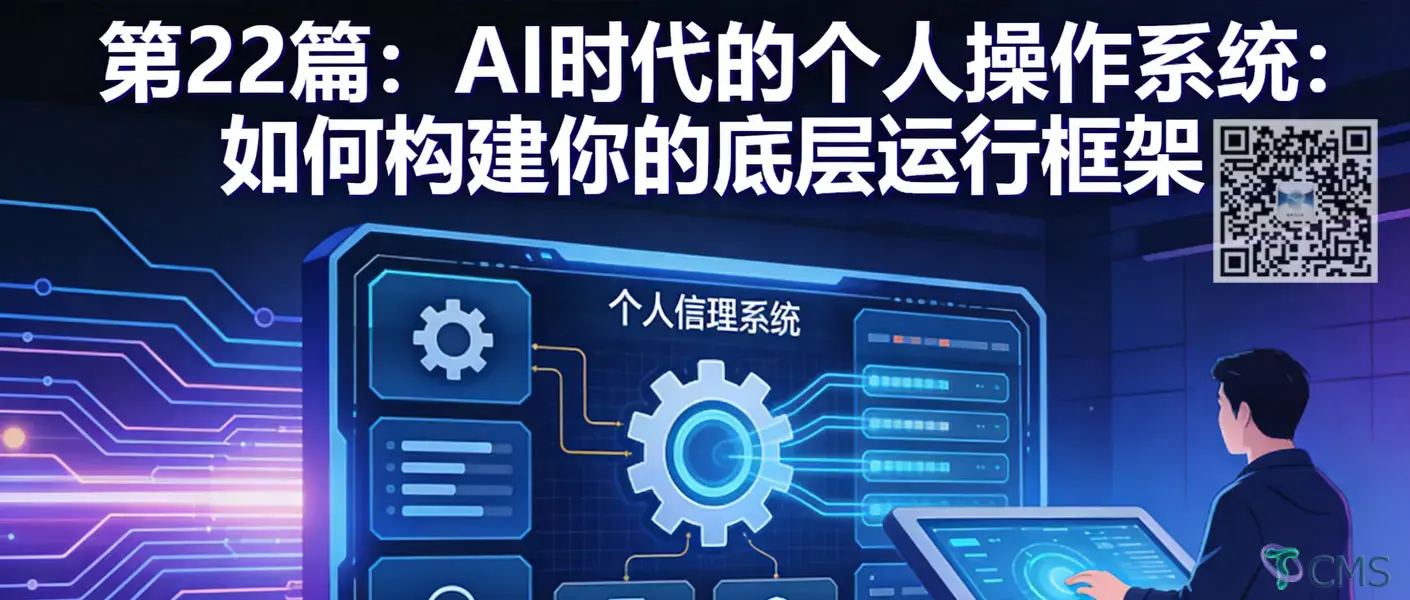
This article builds directly on Article 21 (the training method for core abilities) and takes “abilities” to the next level: a system.
Because in the AI era, what truly determines whether you keep growing, keep advancing, and stay irreplaceable is not skills, tools, or hard work.
It is your Personal Operating System (Personal OS).
Skills become outdated. Tools iterate. Industries restructure. Jobs disappear. But your operating system does not.
In the next decade, real competition will not be “skill competition.” It will be operating system competition.
Change in the AI era now outpaces anyone’s ability to update skills.
You cannot survive an exponentially changing world with a “reserve of skills.”
The only thing you can rely on is: a Personal OS that keeps upgrading, adapting, and iterating.
Your OS controls:
The future belongs to people who upgrade themselves—not just their skills.
Your Personal OS is not an app or a tool. It is a 3-layer underlying operating framework.
This is what you started building in Articles 20–21:
Three critical added abilities:
AI can generate scripts, but it cannot build trust for you. The scarcest resource in the future is not information—it is credible people.
Cross-domain integration is about knowledge. Resource integration is about combining: people × information × tools × channels × opportunities. This is the key to upward mobility for ordinary people.
Thinking is not ability. Doing is ability. An OS without execution is just a system on paper.
These abilities never go out of style. They are not replaced by AI—they are amplified by AI. This is your kernel.
Includes:
Tools are like apps. They can be replaced, upgraded, or abandoned at any time. But they must run on top of your core abilities.
Important reminder: Tools are not resources. People and relationships are resources. AI can let you do the work of ten people. But one person + one system + reliable collaborators is the real compounding structure.
Includes:
This is the “operating logic” you use to understand the world, judge trends, and make choices.
Without this layer, you will:
With this layer, you will:
This is the third layer of your OS.
These five steps are the most practical, actionable way for ordinary people to build their own OS.
You need at least three frameworks:
AI + computing power + automation + global restructuring so you know where the next decade is going.
The value chain structure of your industry so you know which layer to stand on.
How to judge whether an opportunity is worth taking:
People without frameworks rely on feeling. People with frameworks rely on structure.
Don’t learn 100 tools. Build a toolchain.
Example:
The goal of a toolchain is not “using tools.” It is making AI your external engine.
You need a structure that compounds over time:
Knowledge is not accumulation. Knowledge is structured, callable resources.
Execution determines whether your system works.
Includes:
The core of an action system is not detailed planning. It is whether you actually complete real things every week.
Examples:
Execution is the engine of your operating system.
This is the most important part of the OS.
You need:
An OS is not built once. It is upgraded continuously.
Skills are replaced by AI. Tools are wrapped by AI. Processes are automated by AI.
But systematic ability is not.
The future belongs to people who:
The most important ability in the next decade is not:
It is: Whether you can keep upgrading your operating system.
People with a strong OS:
Because they can always adapt, restart, and rise.
They don’t just collaborate with AI. They collaborate with people. They integrate both people and AI into their own system.
Skills become outdated. Tools iterate. Jobs disappear. But your Personal Operating System never will.

 Tekin Tian
May 03, 2025

 Tekin Tian
May 03, 2025
 Tekin Tian
Feb 25, 2026

Please enter your email address below and click the subscribe button. By doing so, you agree to our Terms and Conditions.