Exciting news! TCMS official website is live! Offering full-stack software services including enterprise-level custom R&D, App and mini-program development, multi-system integration, AI, blockchain, and embedded development, empowering digital-intelligent transformation across industries. Visit dev.tekin.cn to discuss cooperation!
A practical, daily actionable learning system for the 12 core abilities in the AI era. Avoid fake learning, use AI as a tool, and build real, irreplaceable skills.
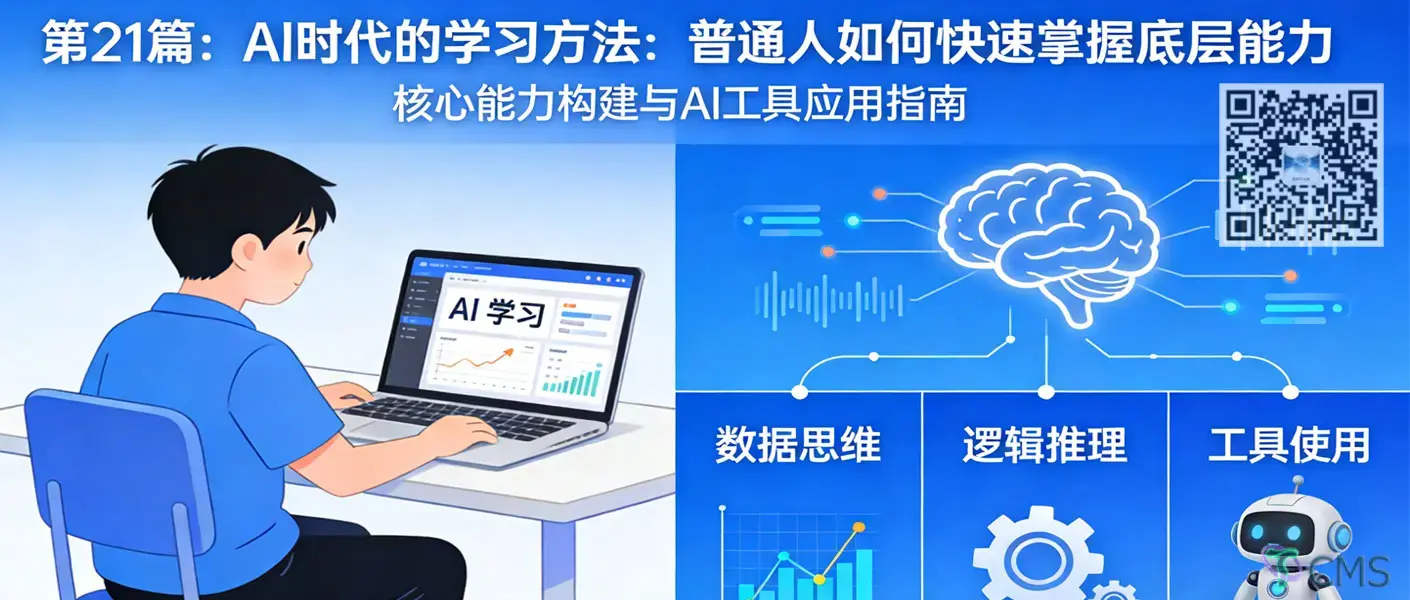
From Underlying Logic Observation Notes (Final Enhanced Edition)
This article continues from Article 20 (the AI-era skill map) and turns “12 underlying abilities to learn” into a practical system you can do daily, implement weekly, and see results monthly.
It does not teach fragmented check-ins, blind practice, or anxious learning. Instead, it fits the AI-era rhythm and helps you master timeless abilities with minimum cost, maximum speed, and highest efficiency.
Following the previous 20 articles: computing power era, position, irreplaceability, career map, skill map… In the AI era, learning ability is core competitiveness; the right method is your shortcut to mastering underlying abilities.
Many people are trapped in learning anxiety:
The logic of learning has been rewritten:
In the past: learning = accumulating knowledge. In the AI era: learning = training abilities.
AI can search, summarize, and organize, but it cannot train these for you:
Real learning is not how much you remember, but how much you can do and create.
AI is a “probability machine,” not a “truth machine.” It produces plausible-sounding content, not necessarily correct facts.
This means:
This is not a bug — it’s how LLMs work.
it’s not judging AI’s output and treating it as authority.
AI is good for:
But you make the final call.
Ask AI:
AI self-corrects, then you judge.
AI amplifies you, but does not replace you.
What truly keeps you irreplaceable:
AI is an add-on. Your underlying abilities are the real you.
Every piece of learning must solve a real problem.
Examples:
Learning without application is wasted effort.
AI is your assistant, not your replacement.
Examples:
Never let AI think for you.
Underlying abilities grow from micro-habits + long-termism.
Examples:
This beats 8-hour cramming weekends.
👉 The biggest trap in the AI era: fake learning makes you feel progressive without real progress.
Each includes: real case + prompt example + scene application.
Example: “How to improve my work efficiency this week?” You break down:
AI check prompt:
“Check if my structured breakdown is complete. Suggest improvements.”
You write:
“I learned structured thinking today, it’s useful.”
AI polishes to:
“10 mins of structured thinking today: I split a complex problem into 3 key parts. I realized I don’t lack solutions — I lack structure.”
Example: AI + Content Creation
AI draft → my experience → AI structure → my emotion → publish
Example: Choose a title AI generates 3 → you choose → AI analyzes → you refine your logic.
Example: Understand “computing power” AI explains → you summarize → note it down.
Example: Analyze your social media data Make chart → write conclusion → AI adds insights.
Example: Write a weekly report with AI You give prompt → AI drafts → you add real details.
Example: Write a long article Break down goal/process/risk → execute → weekly review.
Example: “Why is AI changing every industry?” Break structure → AI supplements → note cognition.
Example: Automate document sorting Notion AI + ChatGPT + tools → save 20 mins/day.
Example: Frustrated by learning Record trigger → write adjustment → AI supports.
Example: Learn a new AI tool Review → find inefficiency → improve → apply same day.
Weekly extra 1 hour: systematic cognition + cross-domain integration.
Ability comes from:
Not how much you watched, but how much you did.
No skill lasts forever. Learning is not a sprint — it’s a lifestyle.
When learning becomes instinct, and underlying abilities become your structure:
AI is your amplifier. The era is your opportunity.
The real goal of learning is not to master more skills. It is:
To always iterate, adapt, and have choices.

 Tekin Tian
May 03, 2025

 Tekin Tian
May 03, 2025
 Tekin Tian
Feb 25, 2026

Please enter your email address below and click the subscribe button. By doing so, you agree to our Terms and Conditions.