Exciting news! TCMS official website is live! Offering full-stack software services including enterprise-level custom R&D, App and mini-program development, multi-system integration, AI, blockchain, and embedded development, empowering digital-intelligent transformation across industries. Visit dev.tekin.cn to discuss cooperation!
This article breaks down the core logic for ordinary people to build cross-era competitiveness. It reframes competitiveness as a replicable, actionable system of six core abilities, helping individuals maintain their value, position, and choices amid technological and cyclical changes.
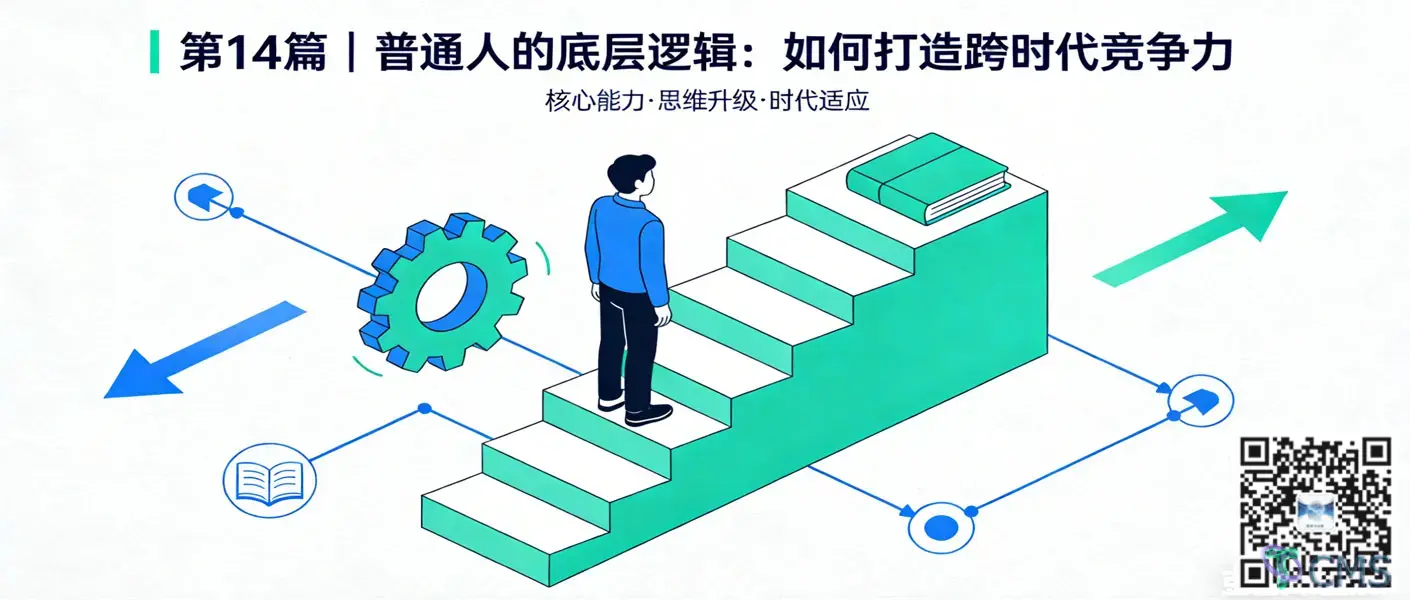
Note 14 of Underlying Logic Observation: Cross-era competitiveness means you still have a place, value, and choices amid any technological and cyclical changes.
—— From the "Underlying Logic Observation Notes" series
In this note, we turn "cross-era competitiveness" from a grand, distant, empty slogan into a practical ability system that ordinary people can truly build, train, and continuously upgrade.
It is not motivation, but a method; Not metaphysics, but a structure; Not a talent, but a replicable, actionable, and iterable path.
Following the previous 13 notes—structure, clarity, certainty, moat, antifragility, long-termism, leap... Cross-era competitiveness integrates all these into a survival system that can transcend cycles, technologies, and eras.
Competitiveness in the past relied on:
But competitiveness in the next decade or two has completely changed its rules, focusing more on:
Cross-era competitiveness is not about "being stronger, more intense, or working harder than others". Instead:
You are more adaptable to the future than you were yesterday, And more capable of transcending cycles and changes than most people.
Because we are entering an era of comprehensive generational transition:
In such an era:
The future no longer simply belongs to "the hardest working", "the smartest", or "the most resourceful". It only belongs to one type of person:
Those who can survive across industries, technologies, cognition, and cycles.
Many people think competitiveness means:
These are valuable, but they are only "points" that cannot transcend eras.
Cross-era competitiveness is never a single point, but a self-iterative, self-repairing, and self-upgrading system:
Basic Abilities + Structural Abilities + Era Abilities = Cross-Era Competitiveness
It is not a point or a line, but a stable, solid, and expandable network, Allowing you to have a foothold and room for growth in any environment.
The following six abilities are not empty talk or metaphysics. They are not exclusive to geniuses, but a practical ability system that ordinary people can cultivate, accumulate, and master. Together, they form the core framework for you to navigate the next decade or two.
One of the most important abilities in the next decade is not "being able to code", But understanding how technology transforms industries, positions, rules, and opportunities.
Technology literacy includes:
Technology literacy is not exclusive to programmers, But a basic era ability for everyone.
It’s okay if you can’t code, but if you completely fail to understand technological logic or trends, You will be left behind by the times, just like those who couldn’t use computers or the Internet in the past.
The future world is complex, non-linear, information-overloaded, and emotion-driven. Whoever can stay clear amid chaos will hold the initiative.
Structured thinking helps you:
It allows you to stop being led by information and instead take the initiative to build your own cognitive framework. Structured thinking is the "brain" of cross-era competitiveness.
The most scarce people in the future are not "top experts in a single field", But those who can connect multiple fields to create new value.
Typical forms of interdisciplinary integration include:
The essence of cross-era competitiveness is simple:
You can connect what others cannot, And solve complex problems that others cannot.
When you can bridge two or more fields, you automatically stand out from homogeneous competition.
In the future, "doing well is not enough". You need to make others know, understand, trust, and be willing to cooperate with you.
Communication ability is not about "being good at talking" or "being emotional", but:
Communication ability is the "amplifier" of cross-era competitiveness. No matter how strong your abilities are, if you can’t express them, your value will be hidden.
The greatest certainty in the next decade is uncertainty itself. Risks, fluctuations, black swan events, and industry reshuffles will become the norm.
Antifragility enables you to:
Antifragility comes from a practical structure:
Antifragility is the "moat and safety foundation" of cross-era competitiveness.
Cross-era competitiveness is not a sprint, Nor a short-term burst, but the result of continuous compound accumulation over time.
Long-termism allows you to:
Long-termism is not about "taking it slow", But making continuous, stable, and in-depth investments in the right direction.
Long-termism is the "time engine" of cross-era competitiveness.
Ordinary people can completely build cross-era competitiveness from scratch. You don’t need a background, talent, or early advantages—just follow this step-by-step path:
This is not a talent, but a method; Not luck, but a structure; Not a miracle, but a real path that ordinary people can take.
The ultimate goal of cross-era competitiveness is not to be the strongest, richest, or most dazzling, But to ensure that in any era, any change, or any impact, you can:
Its ultimate meaning is simple:
To live well, calmly, and with choices in any era.

 Tekin Tian
May 03, 2025

 Tekin Tian
May 03, 2025
 Tekin Tian
Feb 25, 2026


Please enter your email address below and click the subscribe button. By doing so, you agree to our Terms and Conditions.