Exciting news! TCMS official website is live! Offering full-stack software services including enterprise-level custom R&D, App and mini-program development, multi-system integration, AI, blockchain, and embedded development, empowering digital-intelligent transformation across industries. Visit dev.tekin.cn to discuss cooperation!
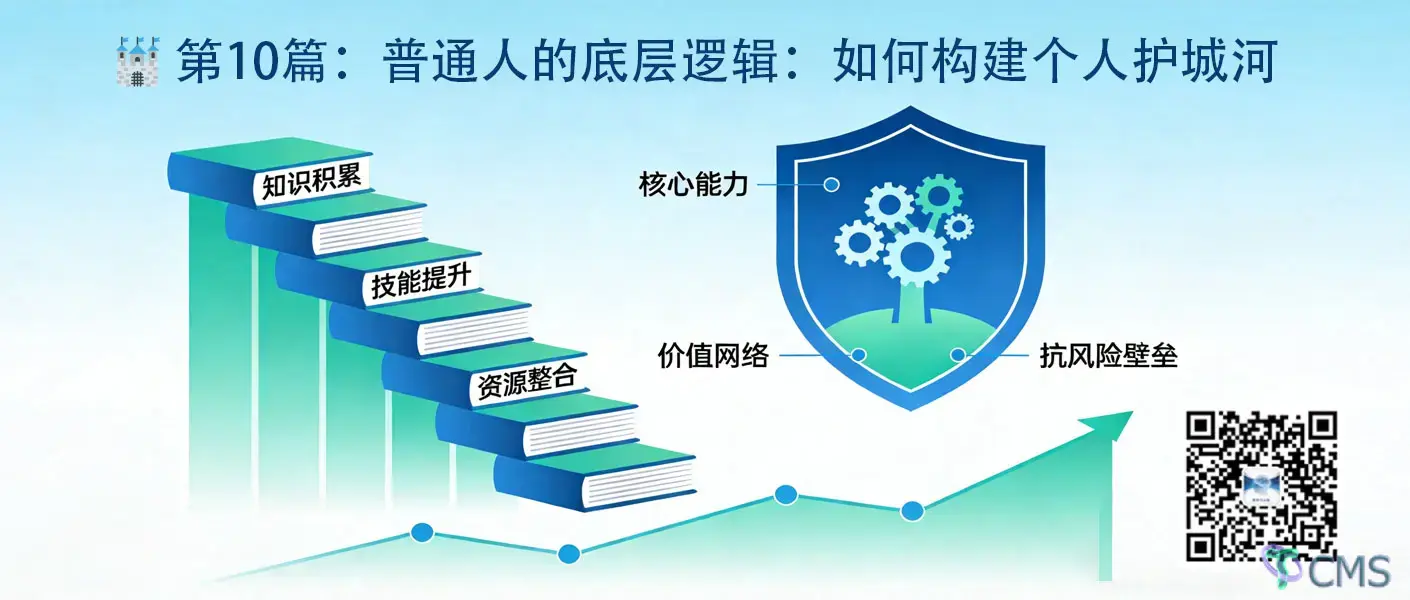
This article explains how ordinary people can build a personal moat, breaking the myth that moats are about talent or resources. It provides five actionable moats—cognitive, skill, relationship, emotional, and anti-fragile—to help you build core advantages and become irreplaceable.
—— Underlying Logic Observation Notes Series
In the previous 9 notes, we have repeatedly emphasized that the core competitiveness of ordinary people lies never in talent, resources, or luck, but in structured advantages + sustainable accumulation.
A personal moat is the concentrated embodiment of such structured advantages.
Many people mistakenly believe that a moat is "innate": a prestigious school, background, connections, or resources.
But for ordinary people, a true moat is never about where you start, but about:
Structure + Time + Compounding.
It is not about "what you have," but about "who you become";
not a single advantage, but a systematic combination;
not built once, but iterated continuously.
A moat is the foundation for survival of ordinary people in an era of drastic changes.
Because the times are changing faster than you think:
People without a moat are like soldiers without armor:
A single industry adjustment, technological change, or accident can break them.
A moat is not an extra bonus, but the bottom line for survival for ordinary people.
A moat for ordinary people is not "being stronger than everyone else," but:
It is hard for others to replace you, and you are hard to be eliminated.
It is a relative advantage, not an absolute one.
It comes from:
The essence of a moat is to make youirreplaceable in competition.
Cognition is not about the amount of information, but about seeing deeper and thinking more thoroughly.
Core capabilities include:
The deeper your cognition, the less likely you are to be swept away by the times.
It is not about "knowing a lot," but about "having one or two skills others cannot replace."
The most worthy skills to invest in for the long term:
A skill moat is the most stable "core asset" for ordinary people.
It is not about "knowing many people," but about "being trustworthy."
A relationship moat comes from:
The essence of a relationship moat is: long-term value exchange.
Emotional stability is the rarest competitiveness for ordinary people.
It comes from:
People with emotional stability are extremely scarce in any era.
Continuing the core logic of Note 7:
Anti-fragility is not about becoming stronger, but about being hard to break.
An anti-fragile moat comes from:
This is the most solid "shield" for ordinary people.
A true moat is a system:
A moat is not a single line, but a system.
The more stable the system, the less likely you are to be replaced.
The ultimate goal of a moat is not to outperform others, but to:
The essence of a moat is to let you always have choices.
The faster the times, the more you need a moat;
The more chaotic the world, the more you need structure;
The more information you have, the more you need judgment;
The more fierce the competition, the more you need irreplaceability.
A moat is not a slogan, but a real path for ordinary people:
Structure + Time + Compounding.
May you steadily build your own moat in this era of drastic changes,
keep your foundation, seize opportunities, and always have the right to choose.

 Tekin Tian
May 03, 2025

 Tekin Tian
May 03, 2025
 Tekin Tian
Feb 25, 2026

Please enter your email address below and click the subscribe button. By doing so, you agree to our Terms and Conditions.