
Exciting news! TCMS official website is live! Offering full-stack software services including enterprise-level custom R&D, App and mini-program development, multi-system integration, AI, blockchain, and embedded development, empowering digital-intelligent transformation across industries. Visit dev.tekin.cn to discuss cooperation!
This article explains the underlying logic of decision-making for ordinary people in an uncertain era. It identifies three common decision-making pitfalls—emotional decision-making, herd behavior, and linear thinking—and provides five practical models to help you make wise choices and avoid detours.
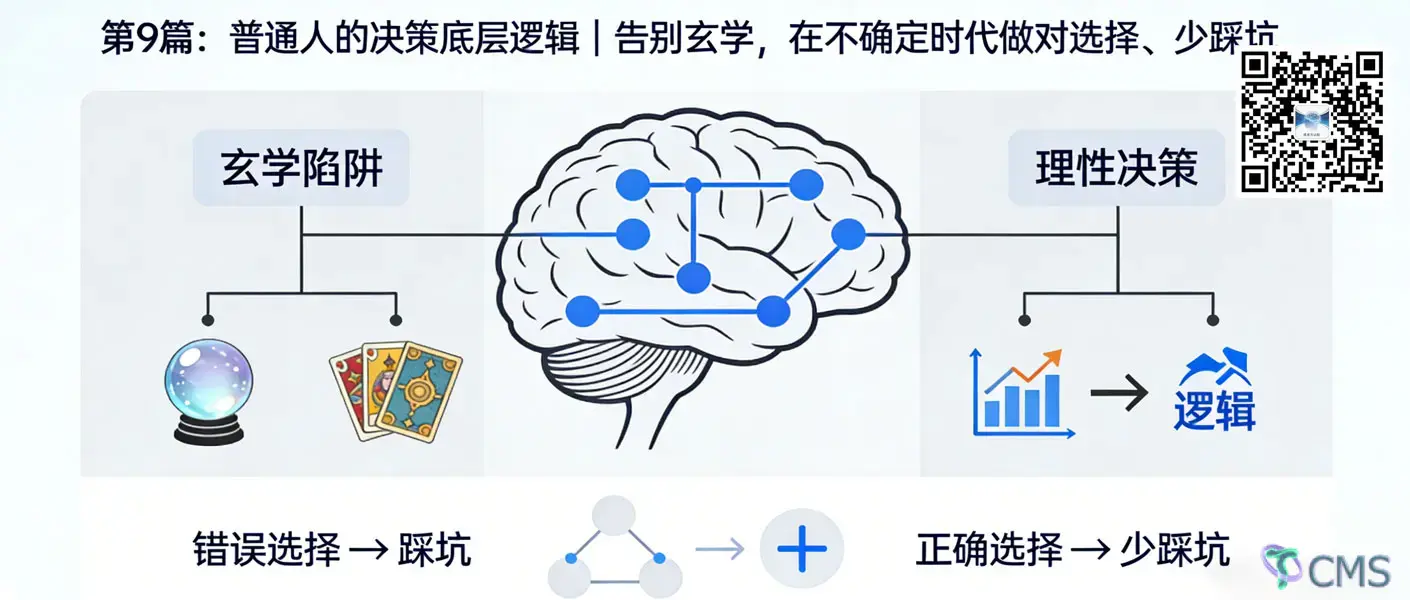
—— Underlying Logic Observation Notes Series
In the previous 8 notes, we have repeatedly emphasized that amid the drastic changes of the times, the core competitiveness of ordinary people lies not in resources, but in structured thinking and actionable steps.
Among all abilities, decision-making ability is the most easily overlooked yet the one that can most profoundly change your fate.
The world used to be linear and predictable: hard work led to rewards, experience translated into results, and stability equated to security.
But today’s world is nonlinear:
The reason ordinary people keep falling into pitfalls is not that they don’t work hard enough, but that they make new decisions with outdated logic.
In an uncertain era, decision-making is not about "choosing correctly," but aboutnot being dragged down by wrong choices.
Being driven by fear or excitement:
Emotion is the biggest noise in decision-making.
Doing what others do.
But in every trend, only a few people make money, while most end up holding the bag.
Assuming the future will be the same as the past.
But in a nonlinear era, old maps won’t lead you to new lands.
Elites predict the future with resources, a luxury ordinary people don’t have.
What we can do is:
Make choices that "won’t break you even if you’re wrong," but "can change your life if you’re right."
This is "asymmetric decision-making," an extension of anti-fragility:
Secure your bottom line first, then pursue success; resist risks first, then talk about growth.
If yes → Go for it
If it will break you → Stay away no matter how tempting it is
One success doesn’t mean a good strategy, and one failure doesn’t mean a bad one.
A good decision is one that brings stable returns in the long run.
Time is more valuable than money.
Wasting time on low-value things is the most expensive cost for ordinary people.
Most people do the exact opposite.
90% of your efforts go to extremely safe things to secure your bottom line
10% go to high-potential things to seize opportunities
This way, you won’t break, and you still have a chance to win big.
The wrong order will waste all your efforts;
The right order, even with imperfect choices, will keep you moving forward steadily.
In an uncertain era, there are no perfect decisions.
What you can do is:
Make the most reasonable choice based on limited information, then adjust continuously.
Decision-making is not about pursuing perfection, but about pursuing:
Correct direction + Controllable risks + Continuous optimization.
The future belongs to those who:
The underlying logic of decision-making for ordinary people can be summed up in one sentence:
Understand the structure, manage risks, and make sustainable decisions.
May you make clearer choices and move forward more steadily in this uncertain era.

 Tekin Tian
May 03, 2025

 Tekin Tian
May 03, 2025
 Tekin Tian
Feb 25, 2026


Please enter your email address below and click the subscribe button. By doing so, you agree to our Terms and Conditions.