
Exciting news! TCMS official website is live! Offering full-stack software services including enterprise-level custom R&D, App and mini-program development, multi-system integration, AI, blockchain, and embedded development, empowering digital-intelligent transformation across industries. Visit dev.tekin.cn to discuss cooperation!
No one can stay out of the drastic changes of the times. The macro trend shapes industries, and industries determine destiny. Ordinary people don't need to predict the future; they only need to understand the underlying structure: choose structurally rising industries, build irreplaceability, expand cognitive bandwidth, develop antifragility, and take the right stance in the times. Sobriety and a sense of the times are your most steady core competencies.
The entire 25-article Underlying Logic Observation Notes series has been completed. For the full table of contents, reading order and audiobook guide, visit the exclusive page on the site: 👉 Underlying Logic Observation Notes - Full Series Catalog (Including Audiobook Guide)
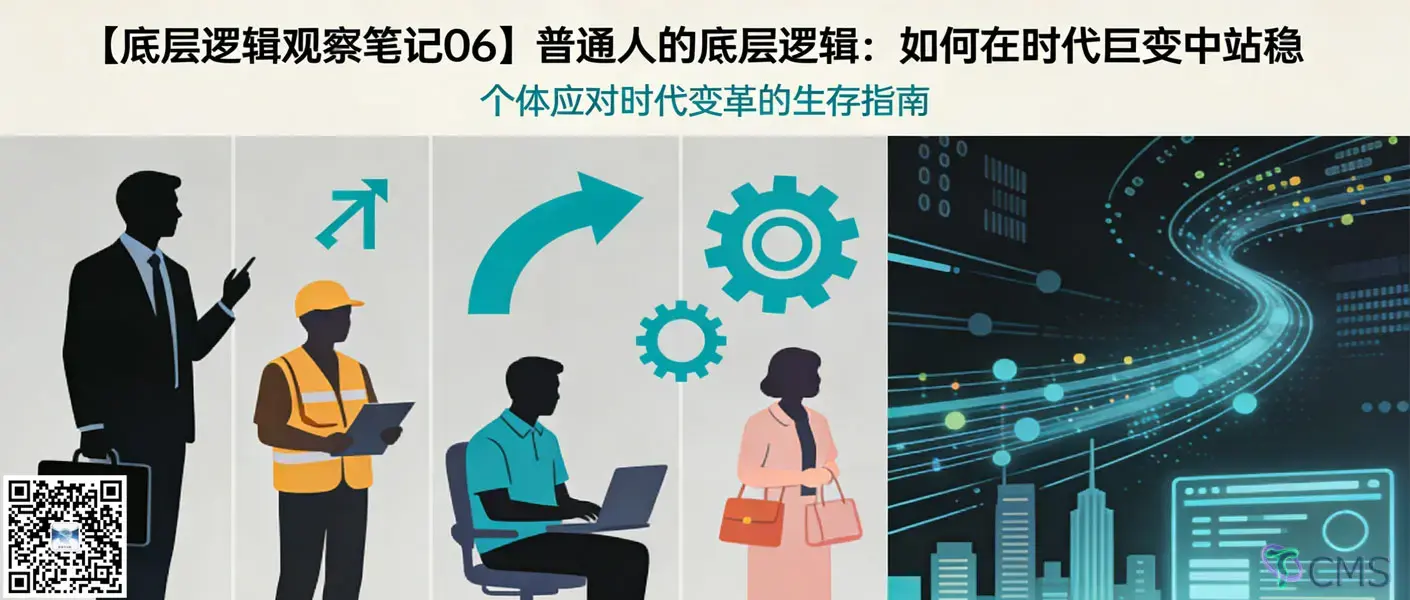
A Survival Guide for Individuals Navigating Era Transformations — Underlying Logic Observation Notes Series
You cannot choose the tide of the times, but you can choose your stance.
This sixth installment of Underlying Logic Observation Notes offers no empty consolations or unrealistic promises, only the most practical and actionable survival logic for ordinary people: Understand the structure, follow the trends, hold your ground, and stand firm amid upheaval.
Golden Quote: If you ignore the macro trend, it will quietly determine your destiny.
The world is experiencing unprecedented changes in a century, and no one can remain untouched:
These profound changes are never distant news, but real tides that shape everyone's destiny— They do not shift with your will, yet they directly determine the trajectory of your industry, the prospects of your job, and even your life.
The biggest misconception of ordinary people is always thinking that "the macro trend is far from me", and that "it's enough to live your own small life well".
But the true underlying logic has always hidden in the connection between the macro and the micro: The macro trend shapes industries, industries determine jobs, jobs decide income, and income defines destiny.
If you ignore technological restructuring, you may be replaced by automation and AI; If you overlook supply chain changes, you may be unaware of being in a declining industry; If you fail to understand the structural logic of the times, you can only drift with the tide and end up being left behind by the times.
The world will quietly influence you even if you pay no attention to it— this is the hard truth ordinary people must recognize in an era of drastic changes.
Golden Quote: Trends change, events pass, only structure remains the unchanging underlying main line for the long term.
We are always anxious about "not seeing the future clearly", and constantly chasing various "trendy opportunities", trying to predict the next profitable track or the next stable job.
But for ordinary people, this is nothing but fruitless internal friction— We lack the ability to predict the future accurately, and the strength to control the direction of the times.
What ordinary people can truly grasp is not predicting the future, but understanding the underlying structure of the times.
Here is a core logic worth engraving in everyone's heart: Structure is more important than trends, trends are more important than events, and events are only superficial phenomena.
Trends are temporary; they may rise rapidly due to policies, capital and emotions, and ebb just as fast; Events are accidental; they are just insignificant epitomes in the process of structural change; Structure, however, is the underlying framework of the times' operation, the unchanging and irreversible core logic— such as demographic structure, technological structure, industrial structure, and global order structure.
The underlying logic for ordinary people can be summed up in one simple yet powerful sentence: Following the structure is always better than fighting against it.
Going against the tide, even if you spare no effort, you will only get half the result with twice the effort, and ultimately be drained by endless internal friction in the tide of the times; Following the structure and moving forward with the power of the times, even if you take small steps, you can advance steadily and stand firm.
Golden Quote: If the direction is wrong, harder work leads to more internal friction; if the logic is wrong, more persistence leads to greater passivity.
In the tide of drastic times changes, many ordinary people are not lazy, but step in the wrong direction and make fatal logical mistakes, ultimately missing opportunities and being eliminated by the times amid internal friction.
Among them, these three mistakes are the most common and worthy of vigilance:
But now, the times have changed, and these once-effective paths have long been completely invalid.
For example, the once-coveted "stable jobs" are no longer stable amid technological restructuring and industry reshuffling; The prerequisite for the once-true "hard work leads to success" is a correct direction—if the direction is wrong, more hard work brings more internal friction; The once-accepted "the more information the better" is now obsolete, as information is overabundant; the more useless information you take in, the easier it is to get lost and consume your cognitive bandwidth.
The underlying structure of the times has changed, and our way of thinking must evolve with it. Clinging to old logic and rejecting new changes will only leave you far behind by the times.
And emotions are precisely the most manipulable resource.
Many ordinary people fall into anxiety after seeing a negative news story; blindly follow the trend after reading others' success stories; regard an extreme opinion as the truth after hearing it.
They think they are thinking independently, but in fact, they are just being pushed forward by others' emotions and narratives.
Failing to distinguish between emotions and judgments, opinions and facts is the most fatal cognitive shortcoming of ordinary people— It will make you make wrong choices, miss real opportunities, and ultimately waste your life in emotional internal friction.
But the most common mistake ordinary people make is being led astray by short-term fluctuations, and taking temporary ups and downs as long-term trends.
For example, resigning in a hurry to change careers when an industry cools down temporarily; investing money and time blindly when a trend booms for a short while; falling into self-denial when a company lays off employees in a certain position temporarily.
These behaviors all stem from mistaking short-term fluctuations for long-term trends.
Truly capable ordinary people know how to filter out short-term noise and seize long-term trends— Only by not being swayed by temporary gains and losses, and not being trapped by short-term emotions, can you hold your own pace in an era of drastic changes.
Golden Quote: Don't gamble on trends, don't rely on luck; rely on structure and strategy to walk the whole journey steadily.
Drastic changes in the times are not terrifying; what is terrifying is being in the midst of upheaval without any coping logic and strategies.
Here are five actionable and implementable underlying strategies to help ordinary people stand firm, avoid risks and seize opportunities in the tide of the times, advancing steadily even if the pace is slow:
Structurally rising industries, however, are the inevitable choice of the times and the unchanging trend for the long term, advancing steadily in the long run even with short-term fluctuations.
The most stable structurally rising industries in the next decade that everyone should focus on:
Standing in a structurally rising industry, you don't need to run fast to be pushed forward by the times; even as an ordinary person, you can ride the wind of the industry to achieve a life turnaround.
But in fact, hard work is a foundation, not an advantage— You can work hard, and so can others; you can work overtime, and so can others.
In an era of drastic changes, the real advantage is never "hard work", but irreplaceability.
Irreplaceability means you can do what others can't, and solve problems that others can't:
Irreplaceability is the most solid amulet for ordinary people in an era of drastic changes— Even if the industry fluctuates and jobs are adjusted, you can quickly find a new foothold with your irreplaceability.
Many ordinary people think that the more information they take in, the higher their cognition; the broader their vision, the clearer their direction.
But the truth is the exact opposite: the more information you have, the easier it is to get lost; the more miscellaneous your intake, the easier it is to be confused.
What is truly scarce is not information intake, but cognitive bandwidth.
Cognitive bandwidth refers to your ability to filter out useless information, see the essence of things, and make correct judgments, including:
The larger your cognitive bandwidth, the clearer you can see the structural logic of the times, the better you can seize long-term trends, and the less likely you are to be swayed by the times and consumed by emotional internal friction.
True security is not "stability", but antifragility— the ability to not only withstand shocks, but also grow amid fluctuations.
For ordinary people, six steps are enough to develop antifragility:
The more you can withstand shocks, the freer you are; the more antifragile you are, the safer you are.
In this era, position is more important than hard work, and choice outweighs effort.
Which industry, city, industrial chain and platform you stand on determines what you can see, access and seize.
Standing in the wrong position, no matter how hard you work, it is in vain; standing in the right position, you can seize opportunities easily even by just following the trend.
Find the right position in the times and follow the structural logic, and you can ride the power of the times to achieve a life turnaround.
Golden Quote: Skills become obsolete, jobs are eliminated, only a sense of the times never falls behind.
Many people are desperately learning skills and improving their abilities, thinking that mastering core skills is enough to stand firm in an era of drastic changes.
But in fact, skills become obsolete and jobs are eliminated, only a sense of the times is the most core and timeless competitiveness for ordinary people.
A sense of the times is not the ability to predict the future, nor the strength to control the times, but the ability to perceive where the world is heading, understand the underlying structure of the times, and adjust your direction a step ahead of others.
People with a sense of the times will not be trapped by short-term noise, bound by old logic, or miss long-term opportunities; even without top-notch skills or abundant capital, people with a sense of the times can find their own position and seize the opportunities that belong to them in the tide of the times.
Golden Quote: The more chaotic the world, the more sober you need to be; the fiercer the tide, the firmer you need to stand.
The more noisy the world, the more you need a calm mind; the more confused the information, the more you need structured cognition; the more turbulent the times, the more you need a long-termist mindset.
In the current era, opportunities coexist with risks, and hope goes hand in hand with confusion.
Many people are consumed by anxiety, learn nothing from blind following, and get lost in impetuosity, ultimately achieving nothing— the core reason is a lack of sobriety.
Blind optimists ignore the risks of the times and overestimate their abilities, ultimately falling into a slump after shocks; Blind pessimists deny the opportunities of the times and magnify their own insignificance, ultimately missing the future in confusion.
True sobriety means being able to both see the structural logic of the times and recognize your own abilities; seize long-term opportunities while avoiding potential risks; follow the tide of the times while holding your own pace.
The underlying logic for ordinary people is never complicated; it can be summed up in one sentence: Understand the structure, follow the structure, stand firm in the drastic changes of the times, hold your ground, and seize the life opportunities that belong to you.
May we all remain sober, adhere to long-termism, not be swayed by emotions or bound by old logic, hold our ground, seize opportunities in the tide of the times, and be participants of the times, not bystanders.
#UnderlyingLogic #UnderlyingLogicObservations #Antifragility #Cognition #CoreCapabilities #StructuralLogic

 Tekin Tian
May 03, 2025

 Tekin Tian
May 03, 2025



Please enter your email address below and click the subscribe button. By doing so, you agree to our Terms and Conditions.