
Exciting news! TCMS official website is live! Offering full-stack software services including enterprise-level custom R&D, App and mini-program development, multi-system integration, AI, blockchain, and embedded development, empowering digital-intelligent transformation across industries. Visit dev.tekin.cn to discuss cooperation!
This is the 3rd installment of the Underlying Logic Observation Notes series, centering on the core proposition that geopolitics is the skeleton of destiny. It reveals that geopolitics is not merely a cold map, but an underlying framework that determines national security, industrial rise and fall, and personal choices. The article dissects the cruelty of geopolitics...
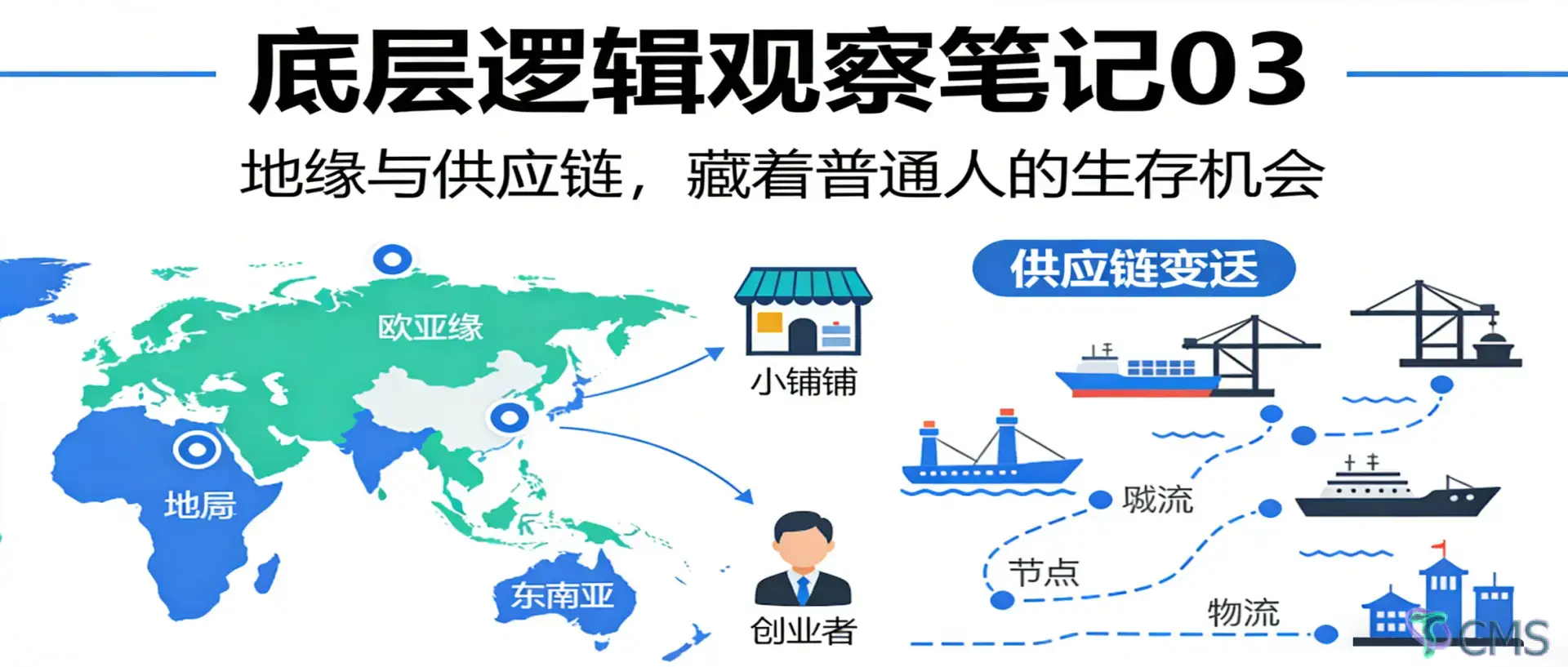
Grasp This, and You Grasp the Underlying Logic of Global Operation — Underlying Logic Observation Notes Series
Many people only read the news, not the logic; only see events, not their roots. Geopolitics is the quietest yet cruelest underlying framework hidden behind all international trends, industrial ups and downs, and personal choices. After reading this, you will rethink: why nations make certain decisions, why industries rise and fall, and what silently shapes your own destiny.
Throughout human history, the world has always been driven by two forces: One is a variable that can be altered through personal effort, organizational reform, and technological breakthroughs, carrying the potential for opportunities and breakthroughs; The other is a constant that is innate and irreversible, defining the underlying boundaries of survival and development.
Geopolitics undoubtedly belongs to the latter.
Many equate geopolitics with territorial divisions, mountains and rivers on a map, yet overlook its essence—it is an invisible, intangible skeleton of destiny that runs through all ages. This skeleton profoundly determines a nation’s territorial boundaries, security landscape, conflict trends, trade routes, and even the rise and fall of civilizations.
It is like an invisible hand manipulating a nation’s development trajectory and shaping the future of a nation behind the scenes.
You may choose to ignore geopolitics, disregard international trends, and overlook border games, but geopolitics will never ignore you. Its influence permeates the lives of every nation, every organization, and every ordinary person through trade fluctuations, energy prices, industrial trends, and security environments. Neither a nation’s strategic decisions nor an individual’s career choices can ultimately break free from the constraints of this underlying geopolitical framework.
Golden Quote: Geopolitics is never just cold lines on a map, but an invisible skeleton of destiny that runs through all ages and shapes all fates.
On the global stage of game theory, strength is certainly important—armies can be forged, resources accumulated, technology advanced, and economies developed, all of which can be achieved gradually through acquired effort and accumulation.
But geopolitics is different. It is a nation’s innate genetic code, a destiny engraved on its territory—unselectable, unchangeable, and irreversible.
A nation’s geopolitical endowment defines the core dimensions of its survival and development from the moment of its birth, directly setting its strategic ceiling and risk baseline:
This is why some nations are destined for turmoil: trapped in the cracks of great power games and standing at the forefront of civilizational conflicts, they can never escape the grip of geopolitical destiny, even if their own strength is not weak.
In contrast, other nations are naturally secure: blessed with a unique geopolitical location, they are far from conflict hotspots and enjoy a stable development environment.
This is not a result of greater wisdom or harder work, but of who is unfortunately stranded on the fault lines of geopolitics, and who is luckily positioned in its safe zones. The cruelty of geopolitics lies precisely in its irreversible innateness.
Golden Quote: Strength can be pursued acquiredly, but geopolitics is innate—that is its cruelest underlying logic.
In the global geopolitical landscape, certain regions are born to be epicenters of contradictions. Endowed with unique locations, resources, and civilizational attributes, they become the focus of great power games and breeding grounds for conflicts. These are the typical geopolitical fault lines, their fates never in their own hands but firmly bound by geopolitical forces.
Ukraine’s turmoil is never due to its own weakness, but to its critical location: situated between Europe and Russia, it is the boundary between Orthodox and Western Christian civilizations, and Russia’s last strategic buffer against the eastward expansion of Western forces.
This innate geopolitical positioning has trapped Ukraine in the vortex of great power games since its birth. No matter whether it tilts east or west, it is bound to touch the core interests of one side, ultimately becoming a victim of geopolitical games.
The chaos in the Gaza Strip is the result of overlapping geopolitical, religious, resource, and historical contradictions. Located on the eastern coast of the Mediterranean, it is the core of the territorial dispute between Palestine and Israel, and a convergence point of Judaism, Christianity, and Islam—the world’s three major religions.
Small in territory and scarce in resources, it bears the interests and religious emotions of all parties. A tiny friction can trigger local conflicts and even send ripples across the global landscape. Its fate has long been locked by multiple geopolitical contradictions, with no easy way out.
Taiwan’s geopolitical value has long transcended mere territorial scope. It is an inalienable part of China’s territory, and more importantly, a core node of the global supply chain and a key hub of maritime power in the Western Pacific.
For this reason, Taiwan has become a key tool for external forces to interfere in China’s internal affairs and contain China’s development. Its geopolitical importance ensures it remains a persistent geopolitical hotspot in the Asia-Pacific region.
The South China Sea is not merely a "maritime territorial dispute", but the most important game field for global maritime power in the 21st century. Rich in oil, gas, and fishery resources, it is also one of the world’s busiest maritime trade routes, through which more than one-third of global maritime trade passes.
Connecting the Pacific and Indian Oceans, it is the only way for East Asian nations to reach the Middle East, Europe, and Africa. Control over its maritime power directly determines the energy and trade security of relevant nations. The game in the South China Sea is therefore essentially a struggle for the future global maritime order and a collision of great power geopolitical strategies, not a simple dispute over territorial ownership.
A common thread runs through these geopolitical fault lines: their turmoil and strife are never due to their own weakness, but to their overwhelming importance in the global geopolitical landscape—they are either strategic buffer zones, resource-rich areas, trade hubs, or civilizational convergence points. This innate importance dooms them to be the focus of great power games, and their fates to be filled with uncertainty and cruelty.
Golden Quote: The destiny of geopolitical fault lines is never rooted in their own weakness, but in being trapped in the core vortex of great power games.
Geopolitics shapes national destiny not through one-dimensional influence, but by building distinct development environments and strategic orientations that propel nations onto different development trajectories. This shaping power is reflected in all aspects of national development: from development models and strategic choices to economic structures and foreign policies, all bear the profound imprint of geopolitics.
Differences in geopolitical location directly determine a nation’s development model and strategic orientation.
Geopolitically endowed resource endowments directly determine a nation’s economic structure and development resilience.
For the world’s great powers, geopolitical advantages are often innate structural dividends—not attainable through policy adjustments, but determined by innate conditions such as territorial area, geographical location, and resource endowments.
These geopolitical advantages of great powers are not the result of short-term policies, but destiny dividends engraved on their territory. They provide innate conveniences for national rise and development, and become the core confidence of great power games.
Golden Quote: Geopolitics shapes development models, determines economic resilience, and is the innate confidence of great power rise.
China’s geopolitical structure is unique on a global scale: It is both a continental power and a maritime power; It boasts abundant resource endowments and a vast heartland, while controlling vital maritime trade routes; It stands at the core of East Asian geopolitical games, while being deeply integrated into the global industrial and supply chains.
This unique geopolitical structure endows China with unparalleled development advantages, while also presenting numerous complex geopolitical challenges.
It is this geopolitical landscape of coexisting advantages and challenges that defines China’s strategic choices:
These strategic choices are not products of subjective will, but inevitable paths determined by the geopolitical landscape.
Golden Quote: China’s geopolitical landscape features coexisting advantages and challenges, and is the underlying foundation of its strategic choices.
Many people view geopolitics as a national-level strategic issue, a concern for politicians, diplomats, and military experts, having nothing to do with ordinary people. In fact, geopolitics is never distant international news, but an underlying logic closely linked to every ordinary person’s life, work and future—its influence permeates all aspects of daily life through layer-by-layer transmission.
Understanding geopolitics is essentially understanding future risks and opportunities, which directly impacts:
The world is currently entering a period of global systemic restructuring, where the intensity of geopolitical games is escalating, and the influence of geopolitics is magnified tenfold or even a hundredfold. In this era, failing to understand geopolitics means failing to read industrial development trends, failing to predict future risks and opportunities, and being forced to follow blindly and make reckless decisions amid era transformations.
For ordinary people, understanding geopolitics is not about participating in international games, but about better grasping personal destiny and making more rational choices in a complex era.
Golden Quote: Understanding geopolitics is not for idle talk, but for not being swept away by the times in an era of great changes.
Geopolitics is an objectively existing underlying logic. It will not disappear because you ignore the news, stop influencing you because you don’t care, or change its operating laws because you escape. It is the skeleton of the world, supporting the operation of the global landscape; it is the framework of destiny, defining the development boundaries of nations and individuals.
In this era where geopolitical influence is extremely magnified, sobriety has become a scarce ability. This sobriety is not anxiety or panic about geopolitical risks, but a profound insight and rational cognition of geopolitical logic; it is not blind following of international trends, but accurate judgment and proactive response to them.
Only by staying sober can you see through the superficiality of international news and understand the underlying geopolitical game logic; Only by staying sober can you see the underlying drivers of industrial development and seize the development opportunities brought by geopolitics; Only by staying sober can you avoid losses caused by geopolitical risks and stand firm in a complex era.
To understand geopolitics is to understand the underlying logic of the world; To read geopolitics is to read the future development trends.
In the geopolitical era, staying sober is the way to forge ahead steadily.
Golden Quote: Geopolitics is the skeleton of destiny; sobriety is the armor of the times.
#UnderlyingLogic #UnderlyingLogicObservations #CognitiveUpgrade #Geopolitics

 Tekin Tian
May 03, 2025

 Tekin Tian
May 03, 2025



Please enter your email address below and click the subscribe button. By doing so, you agree to our Terms and Conditions.