
Exciting news! TCMS official website is live! Offering full-stack software services including enterprise-level custom R&D, App and mini-program development, multi-system integration, AI, blockchain, and embedded development, empowering digital-intelligent transformation across industries. Visit dev.tekin.cn to discuss cooperation!
This is the 2nd installment of the Underlying Logic Observation Notes series, centering on the core theme that Technology Is the New Language of Power. It dissects the three defining traits that make technology the core carrier of power in the digital age, interprets the key arenas of global technological competition, and helps you grasp the inherent power attribute of technology, see the essence of future competition clearly, and align your personal development with the trends of the times.
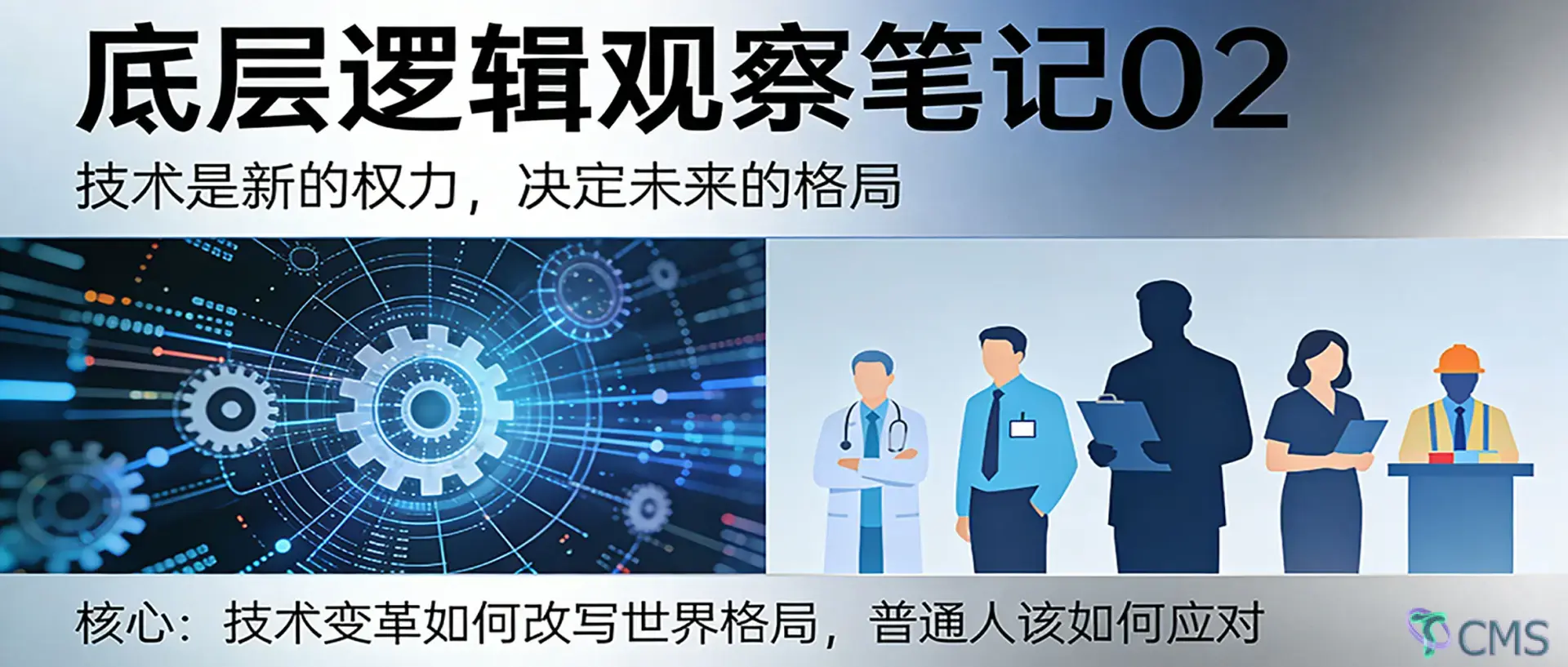
Core: How Technological Transformation Reshapes the Global Order & How Ordinary People Can Adapt — Underlying Logic Observation Notes Series
Looking back at history, power took clear, tangible forms with distinct physical imprints: ironclad armies marching across battlefields, vast territorial domains, rich reserves of natural resources, and large population bases.
These concrete, quantifiable forces formed the core backbone of power before the industrial age. Whoever controlled these hard resources held the unshakable leverage to dominate regional landscapes and shape global trajectories.
Entering the digital age, power has undergone a quiet metamorphosis: it has become invisible and intangible, shedding its traditional physical shell to permeate every corner and link of the world in an entirely new form. It is the core computing power enabling the Internet of Everything, the underlying algorithms dictating decision-making logic, the supply chain networks connecting global production, the data resources hosting massive information, the precision chips driving the intelligent revolution, and the energy technologies sustaining modern industrial operations.
Without a single roar, they reshape the global order and rewrite national destinies in silence; without clear boundaries, they cross geopolitical barriers to profoundly influence a nation's rise and fall, and a civilization's long-term future.
If the core of power in the industrial age was steel and oil—a direct collision and contest of hard power—then the core of power in the digital age is technology itself. It is no longer a mere auxiliary tool serving power, but a new language that restructures power order, defines power rules, and conveys power will.
Technology has supplanted traditional forces to become the core carrier of power in the digital age essentially because it possesses three foundational traits that traditional forces can never replicate. These traits have completely revolutionized how power is accumulated, transmitted and exerted, transforming the very form and logic of power—and cementing technology's status as an irreplaceable core of power.
The core resources of traditional power are inherently scarce and non-replicable: building a tank demands enormous steel, labor and time, with no possibility of unlimited mass production; an oil field has fixed reserves, depleting with every drop extracted until it is exhausted; a nation's territory is innate, impossible to expand or replicate out of thin air.
Technology, by contrast, boasts an unparalleled advantage: unlimited replicability and sustainability—a trait never possessed by traditional power. A mature algorithm, once developed, can be replicated and disseminated at zero cost and without limit, powering countless terminals and serving millions of users; Advancements in computing power rely on technological iteration and architectural optimization, not the consumption of limited resources. As long as technology keeps breaking new ground, computing power grows endlessly, never drying up.
This replicability lets technology spread and exert influence at a pace far surpassing any traditional force in human history. It has also fundamentally altered how power is accumulated and transmitted: no longer through plunder and occupation of resources, but through innovation and iteration of technology.
Geopolitics revolves around boundaries. The clear demarcation of nations, territories and sovereignty has always confined traditional power within physical borders, its influence limited to a country's own territory or sphere of influence.
Technology, however, has shattered this boundary constraint entirely. It has no nationality, no territorial limits, no shackles of geopolitics—and it can penetrate all physical and political barriers at the speed of light. A new energy vehicle supply chain can span ten countries across Asia, Europe and the Americas, with every link from lithium mining and chip manufacturing to vehicle assembly interwoven tightly into a borderless production network; A short-video algorithm can transcend linguistic and cultural barriers to shape how a billion global users access information, form cognitive habits and make value judgments.
For the first time in history, power has gained true global penetration through technology. It can bypass the obstacles of traditional geopolitical games, act directly on every corner of the world, and exert influence without discrimination.
Traditional forces exert mostly auxiliary, "icing on the cake" effects on society and the economy: a nation may face security threats without a strong military, but it can still maintain basic operations; a nation may develop slowly without abundant resources, but it can still participate in global division of labor.
Technology, by contrast, has long transcended the role of an auxiliary. It has become the underlying architecture and core foundation sustaining all modern operations—like the bedrock of the digital age. Without this solid foundation, the entire edifice of modern civilization would crumble in an instant. Without chips, AI loses its core computing power support, and all intelligent applications become empty talk; Without breakthroughs in energy technology, the traditional industrial system would face energy depletion, the new energy industry would never take shape, and the entire social operation would grind to a halt; Without a stable global supply chain, globalized division of labor would collapse completely, national economies would retreat into isolated islands, and the dividends of collaborative development would vanish forever.
The core value of technology lies in this: it directly determines whether a nation can integrate into the future global system, and whether it can gain a foothold and the power to develop in the digital age.
Global competition in the industrial age was a head-on confrontation of steel juggernauts—a contest of hard power: tank against tank, warship against warship, fighter jet against fighter jet. Victory and defeat were reflected in the gunsmoke of battle and the gain or loss of territory, with outcomes visceral and brutal.
In the digital age, however, global competition has bid farewell to this crude form of confrontation. It has shifted to precision games and in-depth contests in core technological fields. This kind of game has no gunsmoke or artillery fire, yet it is far more decisive than traditional warfare. Its outcome will define the global power structure for decades to come and shape the development destiny of every nation.
Future global competition will focus on six critical arenas. The contest in each arena bears on a nation's long-term future, and every battle determines the ownership of power:
The contests in these six arenas involve life and death without gunsmoke, and determine the future without artillery fire. Their outcomes will directly reshape the global power structure for decades to come and carve out new interest landscapes.
The conclusion is clear and brutal: Whoever masters core technology holds the power to define the future; whoever falls behind in technological competition will be reduced to a passive, vulnerable player in the future global order.
Many hold a naive belief: technology is neutral. It is merely a cold machine, a string of meaningless code, with no stance or bias of its own—its good or evil depends solely on the user's choices and control.
But the reality is cold and profound: Technology is never neutral from the moment of its birth. It inherently carries a power attribute. As technology matures and popularizes, this attribute amplifies its influence endlessly, making it the core carrier of power games.
The power attribute of technology is embodied in four key dimensions. Each dimension highlights its dominance over the global order, market landscape and cognitive orientation; the contest for each dimension determines who holds power:
The advancement of technology is directly proportional to the invisibility of power: the more advanced the technology, the more hidden its power form—no longer visible tanks and warships, tangible territory and resources, but algorithms, data, standards and platforms permeating daily production and life. And the more hidden the power, the more far-reaching its influence: it can reshape the global order, alter national destinies and impact individual lives in silence.
This is the core logic behind technology becoming the new language of power: it wields tangible power in an invisible form; it commands the overall situation with a hidden posture.
In this wave of global power restructuring centered on technology, China's technological rise is by no means accidental or a stroke of luck—it is an inevitable result of the superposition of multiple structural advantages.
These advantages are not isolated excellence in a single field, but systematic support covering industry, talent, capital, market, institutions and more. They are core competencies forged through years of accumulation and precipitation, allowing China, for the first time in an era dominated by technology, to have the unshakable confidence to compete with the world's great powers on the same stage and fight for discourse power.
China's technological rise is built on six core structural advantages, which support and empower each other to form a complete ecosystem for technological breakthroughs and industrial upgrading:
The superposition of these advantages has transformed China from a follower in the past to a runner-up, and even a leader, in some fields of global technological competition.
As Chinese technologists, we are born at the right time, fortunate to witness and participate in this great era of transformation. We are neither bystanders nor passive participants in this change, but core builders and drivers. Every technological breakthrough we make, every patent we innovate, every moment of perseverance and dedication—all contribute to China's technological rise, help China seize a more favorable position in the future global power structure, and contribute to the great rejuvenation of the nation.
Technology is never just cold machines and code. It has long transcended its attribute as a tool to become the language, currency, boundary and order of the digital age.
To understand technology is essentially to understand the power structure of the future: understanding the iteration logic of technology allows one to predict the evolution trend of the global landscape; mastering core technological capabilities enables one to seize the initiative in future power games; grasping the power attribute of technology helps one avoid risks and seize opportunities.
In this age where technology defines everything, technological literacy is no longer an exclusive ability of professionals—it is a core survival capability for every individual, every organization and every nation. A lack of technological literacy means being unable to read the trends of the times, and only being able to take a passive beating amid transformation; the loss of technological capabilities means being unable to participate in future competition, and only being reduced to a bystander of the times.
Only by understanding technology as this new language of power can we penetrate the fog of the times and see the future direction clearly; Only by mastering core technological capabilities can we stand firm amid the volatile changes of the times; Only by delving deep into technological innovation can we hold our own discourse power and right to survival in the future global order.
This is the mission of the times entrusted to us by technology, and it is also our core confidence to gain a foothold in the future.
#UnderlyingLogic #UnderlyingLogicObservations #CognitiveUpgrade #Technology #PowerLanguage

 Tekin Tian
May 03, 2025

 Tekin Tian
May 03, 2025


Please enter your email address below and click the subscribe button. By doing so, you agree to our Terms and Conditions.