
Exciting news! TCMS official website is live! Offering full-stack software services including enterprise-level custom R&D, App and mini-program development, multi-system integration, AI, blockchain, and embedded development, empowering digital-intelligent transformation across industries. Visit dev.tekin.cn to discuss cooperation!
Human and AI intelligence operate on fundamentally different logical systems. Human logic is meaning-driven: we understand what words represent, reason from evidence, and verify against reality. AI logic is probability-driven: it predicts likely next words based on statistical patterns without comprehension. Cognitive scientist Gary Marcus describes language models as "blind to truth"—they cannot distinguish true statements from false ones.
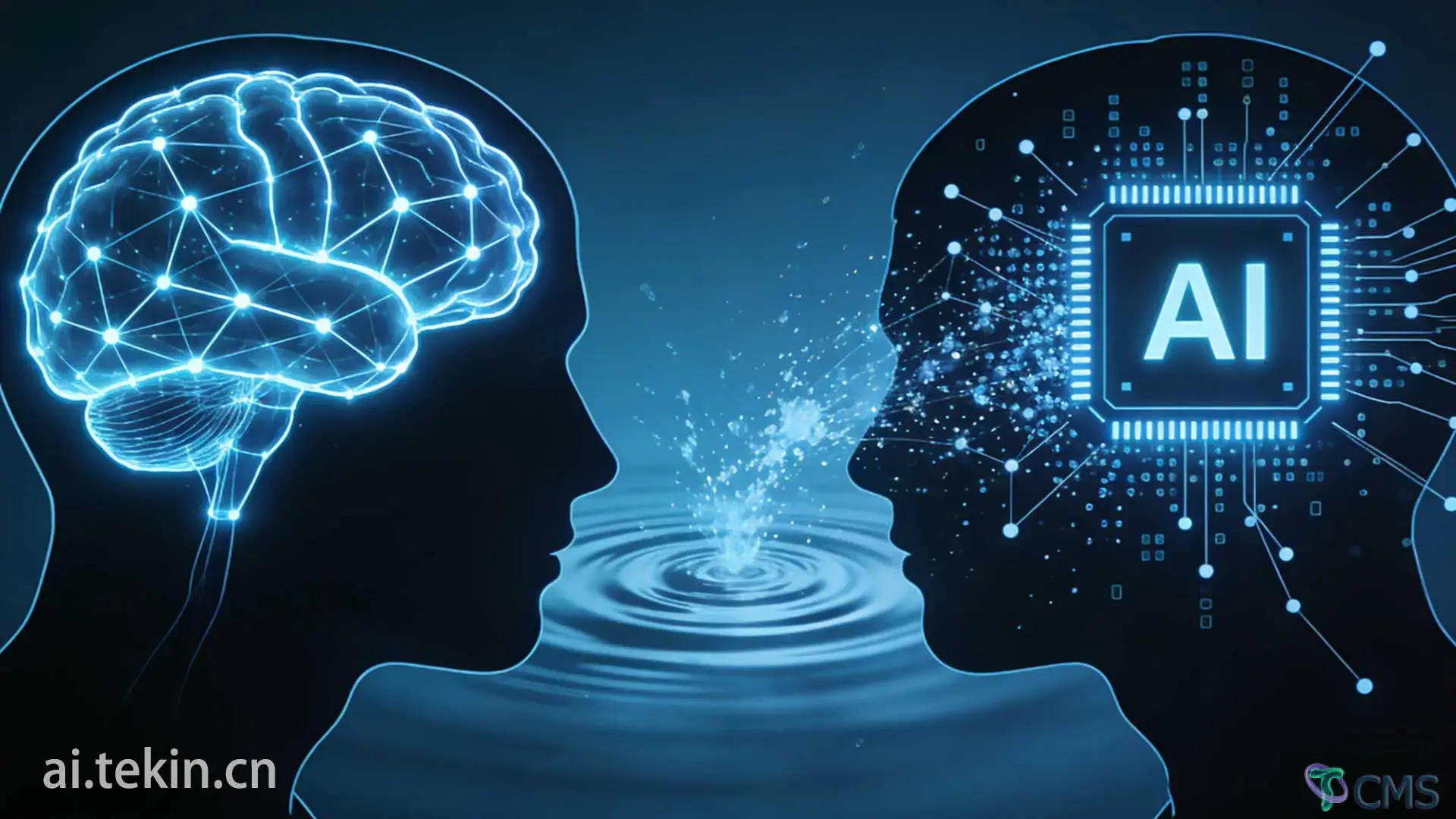
Opening Insight
Humans think through "understanding," AI speaks through "patterns."
When understanding meets patterns, two types of intelligence become misaligned.
AI's problem isn't "insufficient IQ"—it's "a completely different logical system."
You ask it questions, it responds like an expert; you have it write articles, it writes like an author; you have it explain concepts, and it's logical, confident.
So many people assume: "AI's thinking style is similar to humans."
But the truth is:
AI and human intelligence are fundamentally two completely different logical systems.
It just "looks human," but "doesn't think like a human."
Cognitive scientist and NYU emeritus professor Gary Marcus points out: Language models are fundamentally "blind to truth." They cannot distinguish true statements from false ones because their underlying mechanism is predicting tokens, not understanding the world. This isn't a problem that can be solved through "more data" or "larger models"—it's a fundamental difference at the architectural level.
This is the fundamental divergence of two types of intelligence.
Human Logic: Meaning-Driven
AI Logic: Probability-Driven
One sentence summary:
Humans are "understanding the world," AI is "predicting language."
An article in The Conversation points out: Language models learn statistical patterns from text, not meaning from life experience. They don't understand concepts the way humans do—because they've never "lived," never touched the real world, just finding patterns in an ocean of language.
Human cognition is based on: perception, experience, causality, common sense, reasoning, emotion, values.
When you hear a sentence, you: judge whether it's reasonable, judge whether it's true, judge whether it conforms to common sense, judge whether it makes sense.
Human logic is "meaning logic."
For example: When someone says "I just saw a flying pig," your brain immediately starts a "common sense check"—pigs can't fly, so there's a problem with this sentence. You're not checking whether the sentence's "language is coherent," but checking whether it "conforms to your understanding of the world."
AI doesn't have this ability. It has never seen a pig, never seen the sky, never seen flight. It only knows the statistical regularities of words like "pig," "fly," "flying pig" in language.
AI's underlying mechanism is just one sentence:
"Based on what came before, predict the most likely next word."
It won't: judge truth or falsehood, judge reasonableness, judge conformity to common sense, judge meaningfulness.
It will only: make sentences "look reasonable," make language "coherent and natural," make responses "sound like what humans would say."
AI's logic is "language logic."
An arXiv study found: There is fundamental divergence between tasks generated by humans and LLMs. Researchers compared content generated by humans and AI under the same prompts and found completely different thinking paths between the two—humans focus on goals and meaning, AI focuses on patterns and probability.
Because it learned: the tone humans use when explaining problems, the structure humans use when writing articles, the logical chains humans use when expressing viewpoints, the sentence structures humans use when answering questions.
The more it mimics, the more you think it "understood."
But it's not understanding—it's mimicking.
This is like a parrot that has learned to say "Hello." It can say this word, even at the right times, but it doesn't understand what "Hello" means, doesn't know this is a greeting, doesn't know this sentence carries social implications. It just learned "make this sound in this situation."
AI is an upgraded version of that parrot—it can say much more, much more similarly, but it still doesn't know what it's saying.
Because it won't judge: whether your question is erroneous, whether your premise is wrong, whether the content it just generated is real.
It will only continue completing: the most likely next sentence, the most common structure, the logical chain that best fits language patterns.
Thus:
The more you ask, the more it completes; the more it completes, the further from reality.
Gary Marcus wrote in Project Syndicate: Large language models will remain "fundamentally unreliable," with no obvious solution at present. Their problem isn't "not smart enough," but "smart in the wrong direction"—they excel at generating language, not understanding the world.
Because its goal is:
"Make language internally self-consistent," not "make content conform to reality."
So it can generate: self-consistent theories, self-consistent stories, self-consistent explanations, self-consistent logical chains.
But this content might be completely fake.
It pursues "language consistency," not "world consistency."
This is why AI can write a "perfect-looking" paper: abstract, introduction, methods, conclusion, standard format, clear logic—but the cited literature doesn't exist, data is fabricated, conclusions haven't been verified. Everything is normal at the language level, completely fake at the reality level.
Now we can see more clearly the fundamental difference between two types of intelligence:
Human Intelligence:
AI Intelligence:
It has no "understanding" step.
This is why: It can write, it can speak, it can explain, it can generate—but it doesn't necessarily "understand."
Because AI's language is too human-like.
Humans naturally equate: fluency → with understanding, confidence → with certainty, logic → with reasoning, details → with reality, structure → with knowledge.
So you'll think: "It understood."
But it just: "Sounded like it understood."
This is a cognitive trap. We're too used to the equation "speaks like a human = thinks like a human," so much so that we forget to verify whether it holds. AI happens to fall right in this blind spot—it speaks like a human, but doesn't think like a human.
In the future world, humans and AI will coexist for a long time.
To use AI correctly, you must understand:
Human logic is "meaning logic,"
AI logic is "language logic."
When you know their differences, you won't be misled by AI's "anthropomorphic performance."
Gary Marcus calls for: We need "AI models that understand the world," not "AI models that predict tokens." The former can truly reason, plan, and judge truth from falsehood; the latter can only spin at the language level. Before true breakthroughs arrive, understanding the difference between two logics is the first lesson in coexisting with AI.
Understanding this, we can:
Understanding two logics is the most important cognitive ability for the future.
This is Article 8 of the series "The Misalignment of Intelligence: The Underlying Logic of ai-hallucination" target="_blank">AI Hallucination."
Next: "AI Isn't Smart—It's Just Too Good at Sounding Human"
—Why are "speaking human language" and "truly being smart" two different things?
Understanding underlying logic is the first step to understanding the age of intelligence.


 Tekin Tian
Feb 25, 2026
 Tekin Tian
May 03, 2025

 Tekin Tian
May 03, 2025


Please enter your email address below and click the subscribe button. By doing so, you agree to our Terms and Conditions.