
Exciting news! TCMS official website is live! Offering full-stack software services including enterprise-level custom R&D, App and mini-program development, multi-system integration, AI, blockchain, and embedded development, empowering digital-intelligent transformation across industries. Visit dev.tekin.cn to discuss cooperation!
This guide focuses on open-source, free cross-platform desktop UI development frameworks natively compatible with macOS 10.15 and all Windows versions, covering multiple tech stacks including C++, Python, Rust, and Web. From mainstream mature solutions to niche tools, it details the protocols, performance, package sizes, and use cases of each framework, while predicting industry trends from ...
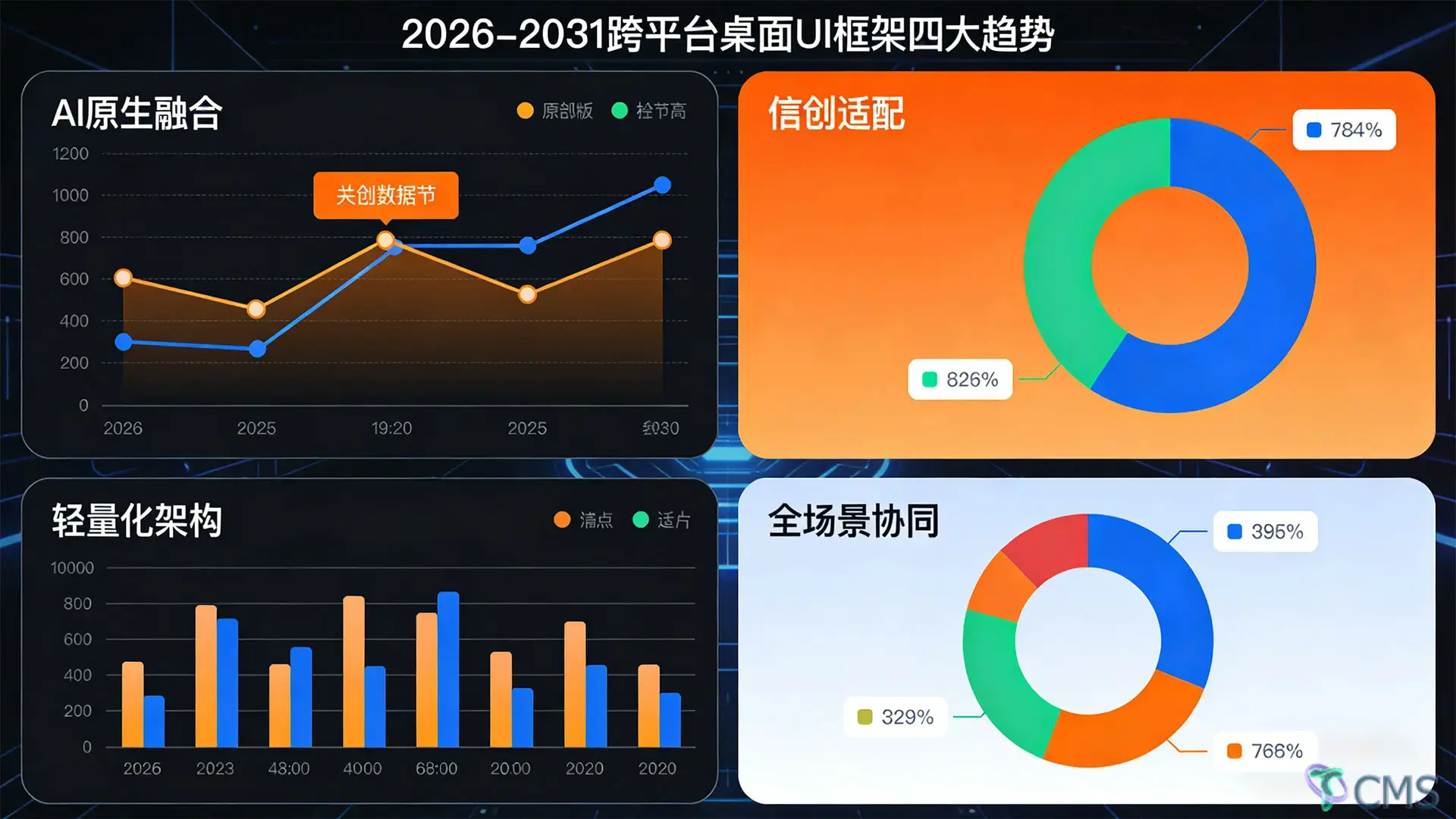
AI-Native Integration
Information Innovation (Xinchuang) Adaptation
In the software development field, cross-platform desktop application development remains a core demand for technical teams—especially for scenarios requiring compatibility with macOS 10.15 (a classic non-Apple Silicon version) and the entire Windows series. Framework version locking, compatibility, and open-source/free attributes are key considerations. In 2026, as digital transformation enters a deep phase, demand for desktop applications in enterprise-level scenarios and professional tool fields continues to recover, while technological iterations of cross-platform frameworks present new characteristics. Based on a comprehensive survey of full-stack frameworks, this article systematically sorts out dual-platform adaptation strategies from mainstream to niche tools and predicts industry trends over the next five years (2026-2031).
As a mainstream legacy version of non-Apple Silicon architecture, macOS 10.15 imposes strict restrictions on framework versions—most major framework versions released after 2023 (e.g., Qt 6, Electron 23+) have abandoned support for it. Therefore, the first principle for 2026 selection is: lock in LTS stable versions or mature pre-2023 versions of frameworks. During packaging, explicitly set the minimum macOS version to 10.15, and ensure Windows compatibility with Win7/10 to cover legacy users.
Meanwhile, the compliance of open-source/free protocols is increasingly important: in 2026, enterprises’ software compliance review standards will rise significantly. MIT/BSD/LGPL protocols can be used unrestrictedly for commercial closed-source projects; for GPL-licensed frameworks, modifying core source code requires open-sourcing, while mere invocation does not require additional authorization. Clear labeling is mandatory at the project initiation stage to avoid legal risks.
Mainstream frameworks boast sound ecosystems, rich documentation, and community support, making them the preferred choice for medium-to-large projects in 2026. Covering core tech stacks such as C++, JS/TS, Dart, and Python, they have been market-proven for stability and implementability.
| Framework | Recommended Version | Open-Source License | Package Size | Core Features | Use Cases |
|---|---|---|---|---|---|
| Qt | 5.15 LTS | LGPL | ~20MB | Rich components, native performance, custom styling support, system API invocation, active maintenance in 2026 | High-performance industrial software, editors, tool-type Apps |
| wxWidgets | 3.1+ | MIT | ~5MB | Pure native widget rendering, system-aligned UI style, strong cross-platform consistency, obvious adaptation to domestic operating systems | Lightweight tools, applications pursuing native experiences |
| FLTK | 1.3.x | LGPL | ~5MB | Extremely lightweight, no redundant dependencies, minimalist API, suitable for resource-constrained scenarios | Ultra-lightweight configuration editors, log viewers |
Selection Advice: Choose Qt 5.15 for comprehensive ecosystems; wxWidgets for lightweight native experiences; FLTK for ultra-small size requirements.
Frontend tech stack frameworks enable direct reuse of HTML/CSS/JS ecosystems, lowering cross-platform development barriers. They remain the mainstream choice for light-to-medium applications in 2026, with lightweight design and high performance as core iteration directions.
| Framework | Recommended Version | Open-Source License | Package Size | Core Features | Use Cases |
|---|---|---|---|---|---|
| Electron | 22.x LTS | MIT | ~80MB | Based on Chromium+Node.js, zero frontend threshold, rich plugins, prosperous ecosystem in 2026 | Admin backends, chat tools, Web-to-desktop applications |
| Tauri | 1.x | MIT/Apache | ~5MB | Based on Rust+system WebView, lighter than Electron, high security, surging enterprise-level cases in 2026 | Lightweight tools, scenarios requiring high performance/small size |
| Neutralinojs | 3.x | MIT | ~1MB | No WebView/Chromium kernel, extremely lightweight, preferred for minimalist tools in 2026 | Minimalist Web-to-desktop applications |
Selection Advice: Choose Electron 22 for frontend teams prioritizing rapid development; Tauri 1.x for lightweight requirements; Neutralinojs for ultra-small size needs.
These frameworks support multi-end operation with one codebase, aligning with enterprises’ 2026 core demand for "full-platform coverage." Their penetration continues to rise in consumer applications and lightweight office tools.
| Framework | Recommended Version | Open-Source License | Package Size | Core Features | Use Cases |
|---|---|---|---|---|---|
| Flutter | 3.10~3.16 | BSD | ~30MB | Self-rendered UI with strong consistency, near-native performance, improving desktop ecosystem in 2026 | Cross-end applications, interactive visualization tools |
| Kivy | 2.1.0 | MIT | ~20MB | Multi-touch support, desktop+mobile adaptation, suitable for touch interaction scenarios | Lightweight interactive applications, mini-games |
Selection Advice: Choose Flutter for big-tech backing and cross-end needs; Kivy for touch interaction scenarios.
Python frameworks offer high development efficiency, remaining dominant in 2026 for data analysis tools and lightweight prototyping. Their integration capabilities with AI toolchains are further enhanced.
| Framework | Recommended Version | Open-Source License | Package Size | Core Features | Use Cases |
|---|---|---|---|---|---|
| PySide2 | Corresponding to Qt 5.15 | LGPL | ~30MB | Python binding for Qt, retaining native performance, reusing Python data analysis ecosystem | Data analysis visualization tools, lightweight applications |
| Tkinter | Built-in with Python 3.6+ | Python Open-Source License | ~10MB | Zero additional dependencies, simple API, suitable for rapid prototype validation | Ultra-lightweight tools, prototype verification |
| PyGObject | Binds to GTK 3.24 | LGPL | ~15MB | Reuses GTK native components, supports data analysis library integration | Python native desktop applications |
Selection Advice: Choose PySide2 for balancing performance and efficiency; Tkinter for minimalist tools; PyGObject for native requirements.
Despite smaller ecosystems, niche frameworks offer irreplaceable advantages in 2026 specialized scenarios—especially embedded devices and professional tool-embedded UIs—by virtue of their lightweight design and high performance.
libui 0.4.0: MIT license, C-written, core library < 1MB, direct system native widget invocation, multi-language binding support, stable demand in embedded desktop applications in 2026.
U++ 2023.12: BSD license, C++ framework with built-in visual designer, compiles to runtime-free executables (~8MB), performance comparable to Qt, suitable for senior C++ developers building lightweight enterprise tools.
imgui 1.89.x: MIT license, immediate-mode UI library, no window system dependencies, embeddable in OpenGL/Vulkan rendering engines, remains the preferred embedded UI solution for 3D editors and scientific computing tools in 2026.
NanoGUI 1.1.x: MIT license, lightweight OpenGL-based UI library, hardware acceleration support, suitable for embedded UI development in 3D editors and data visualization tools.
Rust frameworks, leveraging security and high performance, enter a rapid development phase in 2026, becoming a new option for teams pursuing extreme performance with improving ecosystems.
| Framework | Recommended Version | Open-Source License | Package Size | Core Features | Use Cases |
|---|---|---|---|---|---|
| Slint | 1.2.x | GPLv3 | ~8MB | Declarative UI syntax, compiles to native machine code | Rust high-performance desktop applications |
| Relm4 | 0.6.x | LGPL | ~10MB | Rust binding for GTK 3.24, MVVM architecture | Rust native desktop applications |
| Compositor | 0.1.x | MIT | ~10MB | Compiles native code based on Web standards, modern UI | Rust lightweight desktop application prototypes |
Combining 2026 technical status and industry dynamics, cross-platform desktop UI frameworks will exhibit four core trends over the next five years, profoundly impacting development selection strategies:
Over the next five years, AI will evolve from "auxiliary functionality" to the "underlying architecture" of cross-platform frameworks, with low-code and cross-platform technology integration becoming mainstream. By 2028, 85% of enterprise-level cross-platform frameworks are expected to integrate multimodal large models, supporting features such as "natural language-to-UI prototyping," "intelligent debugging," and "automatic multi-platform style adaptation," boosting development efficiency by 300%-500%. Non-technical personnel can complete 80% of basic development via low-code platforms, while professional developers focus on core logic—forming a seamless collaboration model of "no-code-low-code-full-code."
Driven by policies, key industries such as government, finance, and energy will shift from "optional" to "mandatory" demand for full-stack adaptation of "domestic chips-operating systems-frameworks-applications." By 2030, mainstream domestic cross-platform frameworks are expected to achieve 100% adaptation with Kunpeng, Phytium chips, and UOS, Kylin OS. The market share of domestic frameworks will rise from 25% in 2026 to over 45%. Meanwhile, data security compliance becomes a core competency, requiring frameworks to embed native security capabilities such as encryption, desensitization, and permission control.
Pain points of heavyweight Web frameworks like Electron—"large size and high memory usage"—will continue to be optimized. Over the next five years, hybrid architectures of "system WebView + lightweight backend" (e.g., Tauri, Neutralinojs) will become mainstream, reducing the average application size from 80MB in 2026 to under 20MB. Meanwhile, Rust’s penetration as a backend development language will rise significantly, with framework performance approaching native C++—balancing development and runtime efficiency.
Frameworks will no longer be limited to "desktop" but extend to "desktop+mobile+Web+embedded" full scenarios, with one-codebase multi-end deployment becoming standard. By 2031, 90% of mainstream frameworks are expected to support cloud-end collaboration architectures, enabling features such as application state synchronization, offline work, and cloud computing power scheduling—meeting enterprises’ "full-scenario coverage" and users’ "seamless cross-device experience" needs. Additionally, vertical industry solutions will become more abundant, with frameworks embedding industry-specific components (e.g., industrial control, medical imaging, financial transactions) to lower development barriers for industry applications.
C++ Teams: Qt 5.15 > wxWidgets > FLTK > U++
Frontend Teams: Electron 22 > Tauri 1.x > Neutralinojs > WebView2
Python Teams: PySide2 > PyGObject > Tkinter > Kivy
Rust Teams: Slint > Relm4 > Compositor
Extreme Lightweight (<10MB): Neutralinojs > libui > FLTK
Native Performance: Qt 5.15 > wxWidgets > U++
Cross-End Needs (Desktop+Mobile): Flutter > Kivy
Embedded UI: imgui > NanoGUI
Future Adaptability (Xinchuang/AI): Tauri 1.x > Flutter > Slint
The 2026 selection of cross-platform desktop UI frameworks for macOS 10.15 + Windows centers on "version locking + protocol compliance + scenario matching," while considering technical evolution trends over the next five years. Mainstream frameworks suit medium-to-large projects and team collaboration, while niche frameworks meet extreme specialized scenario needs. Rust ecosystems, AI-native integration, and Xinchuang adaptation will become core competitive advantages.
Development teams should select the most suitable framework based on their tech stack, application type (tools/enterprise/visualization), and performance/size requirements—while reserving technical iteration space to adapt to 2026-2031 industry changes such as AI integration, Xinchuang upgrades, and full-scenario collaboration.
#macos #windows #cross-platform #developmentframework #crossplatformUI #AINativeIntegration #XinchuangAdaptation #lightweightarchitecture #fullscenariocollaboration #frameworkselection
 Tekin Tian
May 03, 2025
 Tekin Tian
May 03, 2025

Please enter your email address below and click the subscribe button. By doing so, you agree to our Terms and Conditions.